
The role of discipleship in church: a 2026 guide


Discipleship in the church is the ongoing process of forming believers to follow Jesus obediently, grow in faith, and make more disciples. The role of discipleship in church is not a programme you complete or a class you attend. It is the living identity of a community shaped by Scripture, centred on Christ, and expressed through everyday relationships and mission. At Divergentchurch in Canberra, this conviction sits at the heart of everything. Understanding what discipleship truly means, and how it works in practice, changes how you see the church and your place within it.
What biblical foundations define the role of discipleship in church?
The church is the God-ordained primary context for discipleship, rooted in the Great Commission of Matthew 28:18–20. Jesus did not suggest disciple-making as one option among many. He commanded it as the defining mission of his people.
“Go therefore and make disciples of all nations, baptising them in the name of the Father and of the Son and of the Holy Spirit, teaching them to observe all that I have commanded you.” — Matthew 28:19–20
This commission involves far more than preaching. It includes baptism, teaching obedience, and the kind of congregational accountability that only a gathered community can provide. The church is not simply a venue for this work. It is the agent of it.
Jesus himself modelled a relational, life-on-life approach to forming disciples. He did not run a curriculum. He called twelve men into proximity with himself, shared meals with them, corrected them, sent them out, and welcomed them back. That pattern, repeated across generations, is what the church is called to embody.
Several passages reinforce this ecclesial role in disciple-making:
Ephesians 4:11–13 describes apostles, prophets, evangelists, pastors, and teachers equipping the saints for works of service, building up the body of Christ.
Colossians 1:28 captures Paul’s aim: “We proclaim him, admonishing and teaching everyone with all wisdom, so that we may present everyone fully mature in Christ.”
2 Timothy 2:2 outlines the multiplication principle: “The things you have heard me say… entrust to reliable people who will also be qualified to teach others.”
The biblical picture is clear. Disciple-making is not the work of specialists. It is the calling of the whole church, expressed through relationships, teaching, and shared life.
How do discipleship and disciple-making differ, and why are both essential?
Discipleship and disciple-making are related but distinct. Confusing them produces churches that either grow inward or scatter without depth.
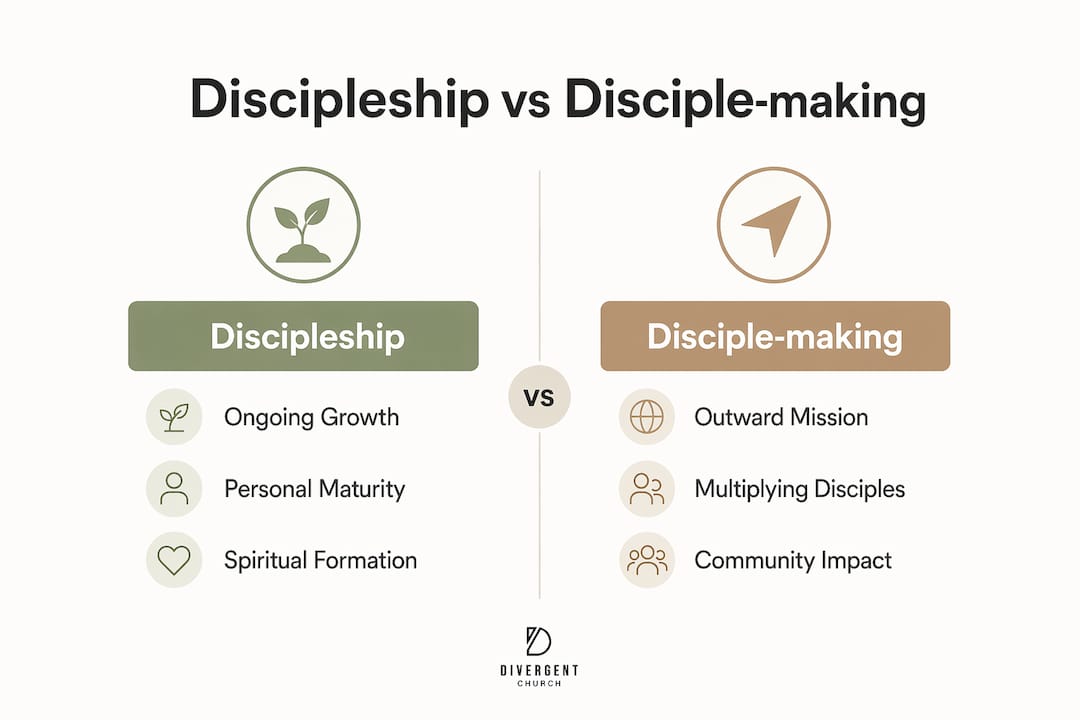
Discipleship refers to the ongoing maturing of a believer. It is the process of becoming more like Christ through Scripture, prayer, accountability, and community. Discipleship is a lifelong identity shaped by participating in Christ’s life and mission, not a post-conversion stage or a curriculum to finish. That distinction matters enormously. When discipleship is treated as a course, people graduate and disengage. When it is treated as an identity, it shapes every part of life.
Disciple-making, by contrast, is the outward movement. It is the work of bringing new people into relationship with Jesus and into the community of his followers. Disciple-making is the church’s identity. When a church stops making disciples, it deprioritises the eternal destiny of the people around it. That is a serious claim, and it deserves to be taken seriously.
Churches that hold both together tend to follow a four-step pathway for disciple-making in practice:
Calling — identifying and inviting people into intentional relationship and growth.
Training — equipping disciples with Scripture, theology, and practical faith skills.
Coaching — walking alongside disciples as they begin to apply and share what they have learned.
Mobilising — releasing disciples to make disciples of their own, completing the multiplication cycle.
This pathway is not a linear programme. It is a repeating rhythm. Each person who is mobilised becomes a caller for someone else. That is how spiritual multiplication works, and it is why church multiplication and discipleship are inseparable concepts.
Pro Tip: If your church only runs discipleship groups without a clear mobilisation step, you are forming mature believers who have nowhere to go. Build the pathway all the way to sending.
What practical strategies support effective discipleship in the church?
Effective discipleship does not happen by accident. It requires intentional structure, clear communication, and relational rhythms that sustain growth over time.
Define what a mature disciple looks like
A sustainable discipleship strategy requires defining maturity before planning anything else. Without a shared picture of what a formed disciple looks like, leaders cannot measure progress and congregants cannot aim at anything concrete. Identifiable traits might include regular Scripture engagement, active participation in a faith community, consistent prayer, and the ability to share faith with others.
Keep the plan simple and repeatable
Most discipleship plans stall because of poor communication and overcomplicated structures. Successful plans have 3–5 easily understood, repeatable steps that any congregant can follow. Pruning programmes that do not serve the core pathway is not a loss. It is clarity.
The following table outlines common discipleship strategy elements and their purpose:
Strategy element | Purpose |
Defined maturity markers | Gives disciples a clear picture of growth to aim toward |
3–5 step pathway | Reduces confusion and increases participation |
Accountability pairings | Builds courage and mutual growth through shared practice |
Simple evangelism tools | Removes friction from everyday faith-sharing |
Active engagement metrics | Measures real discipleship health, not just attendance |
Build relational accountability into the structure
Pairing disciples together in accountability-based practice promotes mutual growth, courage, and practical faith application. This goes well beyond typical group Bible studies. When two people commit to practising faith together, sharing conversations, and reporting back, growth accelerates. The discipleship questions that guide these conversations matter enormously.

Equip with practical tools, not guilt
Using guilt to drive discipleship produces tired, disengaged Christians. Providing simple, free witness tools removes friction and builds genuine confidence in everyday faith-sharing. When people feel equipped rather than condemned, they engage.
Pro Tip: Avoid adding new discipleship programmes before removing old ones. Programme overload is one of the most common reasons discipleship strategies fail to gain traction.
What impact does discipleship have on individuals and church communities?
The impact of discipleship reaches far beyond Sunday attendance. It reshapes individuals and transforms the culture of an entire community.
“The goal of discipleship is not information transfer but life transformation — believers who obey everything Jesus commanded and who reproduce that obedience in others.”
At the individual level, discipleship produces:
Spiritual maturity — a growing capacity to read Scripture, pray with conviction, and make faith-informed decisions.
Obedient living — movement from knowing what Jesus taught to actually doing it, in relationships, work, and neighbourhood life.
Confidence in faith-sharing — disciples who have been equipped and practised are far more likely to share their faith naturally.
Resilience — people formed in community weather hardship with greater stability than those who attend church without relational roots.
At the community level, the effects are equally significant. Churches that prioritise disciple-making develop a culture of mission rather than maintenance. Successful churches track active faith engagement, such as sharing conversations and next steps taken, rather than measuring health by attendance figures alone. That shift in measurement reflects a shift in identity.
Discipleship also extends the church’s presence into the city. When disciples are formed and mobilised, the church stops being a building people visit and becomes a community that inhabits every workplace, university, and neighbourhood. Divergentchurch exists precisely within those rhythms in Canberra, seeking to form disciples who carry the kingdom into the ordinary spaces of daily life.
Key takeaways
Discipleship is the church’s primary calling, and its impact is measured not by attendance but by the formation of obedient, mission-minded followers of Jesus.
Point | Details |
Biblical foundation | The Great Commission (Matthew 28:18–20) makes disciple-making the God-ordained mission of the church. |
Discipleship as identity | Discipleship is a lifelong way of living in Christ, not a programme to complete or a class to graduate from. |
Four-step pathway | Calling, training, coaching, and mobilising disciples creates a repeating cycle of spiritual multiplication. |
Simple, clear strategies | Plans with 3–5 repeatable steps and relational accountability produce far greater engagement than complex programmes. |
Measuring real growth | Healthy discipleship is measured by active faith engagement and mission activity, not attendance numbers alone. |
Why discipleship is the heartbeat of church life, not just a programme
I have seen churches pour enormous energy into weekend services, production quality, and event calendars, only to find that their people remain spiritually thin and relationally isolated. The missing ingredient is almost always discipleship. Not a discipleship class, but a genuine culture of formation.
What I have found, both personally and in watching communities like Divergentchurch grow, is that discipleship changes the texture of a church. When people are genuinely being formed, the conversations in the foyer change. The questions people bring to Scripture change. The way they relate to their neighbours and colleagues changes. It is not dramatic. It is quiet and cumulative, like seeds taking root.
The most common misconception I encounter is that discipleship is for serious Christians, as if it is an advanced track for the spiritually ambitious. That framing is backwards. Discipleship is the normal Christian life. The Great Commission was not addressed to a spiritual elite. It was addressed to eleven ordinary people standing on a hillside in Galilee.
The other thing I would say honestly is this: relational disciple-making is uncomfortable at first. Sitting with someone, asking hard questions, and being asked them in return requires vulnerability. But that discomfort is precisely where growth happens. The joy that comes from watching someone you have walked with begin to walk with someone else is unlike anything a programme can produce.
Prioritise discipleship not as one ministry among many, but as the identity of your community. Everything else flows from that.
— Josh
Grow deeper in discipleship with Divergentchurch
Divergentchurch exists to form disciples of Jesus in the rhythms of Canberra life, and there are real, practical ways to go deeper right now.
The Discipleship Hub is the central starting point, bringing together resources, pathways, and community connections for anyone serious about growing in faith. If you are ready to explore what following Jesus looks like in practice, Follow Jesus is a great next step. For those called to lead others in formation, Lead Like Jesus offers a grounded pathway for servant leadership. Discipleship also happens in the ordinary rhythms of shared life, and Life Communities are where that relational formation takes root week by week in Canberra.
FAQ
What is church discipleship?
Church discipleship is the process by which a Christian community forms believers to follow Jesus obediently, grow in faith, and make more disciples. It is rooted in the Great Commission of Matthew 28:18–20 and expressed through teaching, accountability, and shared life.
Why is discipleship important in the church?
Discipleship is the church’s primary calling because it fulfils Christ’s command to make disciples of all nations. Without it, a church may gather people without actually forming them in faith or equipping them for mission.
How do you disciple someone in a church context?
Effective discipleship follows a relational pathway of calling, training, coaching, and mobilising. It involves regular Scripture engagement, accountability pairings, and practical tools that build confidence in everyday faith-sharing.
What is the difference between discipleship and disciple-making?
Discipleship refers to the ongoing maturing of an individual believer, while disciple-making is the outward work of bringing new people into relationship with Jesus. Both are essential and work together to produce spiritual multiplication within a church community.
How do you measure the impact of discipleship?
Healthy discipleship is measured by active faith engagement, including sharing conversations, next steps taken, and people being mobilised into mission, rather than by attendance figures or programme participation alone.
Recommended
Comments