
Explaining Christian unity: a clear, Bible-first guide


Christian unity is the spiritual oneness that believers share in Christ, modelled on the communion between Father, Son, and Holy Spirit, and given to the church as both a gift to receive and a calling to live out. Jesus prays for it directly in John 17:21–23, asking that his followers be one “just as we are one” so that the world may believe he was sent by the Father. Ephesians 4 grounds it further, urging believers to “make every effort to keep the unity of the Spirit in the bond of peace.” The Prayer for Christian Unity is an annual ecumenical observance that draws this longing into corporate worship across denominations.
Three things are worth holding from the start:
Unity is a Spirit-given reality, not a human achievement. Churches are called to keep it, not manufacture it.
Unity is not uniformity. Shared confession of the gospel is the centre; worship style, secondary doctrine, and cultural expression are not.
A divided church undermines its own witness. As the World Council of Churches has put it, a broken and divided church does not carry a credible message to an already broken and divided world.
Table of Contents
What does Christian unity actually cover?
Unity in the New Testament operates on two levels. The first is ontological: every person genuinely in Christ is already one with every other believer through the Holy Spirit. This is the “invisible” unity of the true church, and it is complete regardless of what denomination someone belongs to. The second is visible: the way that oneness is expressed in shared worship, mutual care, cooperative mission, and public witness. Visible unity is always partial and always in progress.
The scope of unity does not extend to moral compromise or doctrinal relativism. Scripture is clear that church discipline has limits: Matthew 18 and 1 Corinthians 5 both describe situations where persistent, unrepentant sin or false teaching requires the church to act, even when that action disrupts surface-level harmony. Unity pursued at the cost of truth is not biblical unity; it is sentimentality wearing theological clothes.
The real-world scale of visible disunity is striking. The visible church has become highly fragmented since the Reformation. That fragmentation is not the final word, but it is the honest starting point for any serious conversation about unity.
What unity covers, in summary:
Shared confession of the gospel (the person and work of Jesus, justification by faith)
Mutual love and accountability across congregational and denominational lines
Cooperative witness and service where gospel essentials are affirmed
Diversity of expression in worship, culture, and secondary doctrine
What it does not cover:
Institutional merger or organisational uniformity
Silence on sin or false teaching for the sake of peace
Agreement on every theological question
What does the Bible say about Christian unity?
Scripture does not treat unity as a nice ideal. It is woven into the fabric of the gospel itself, and three passages carry the weight of that claim more than any others.

Passage | Core teaching | Application for churches today |
John 17:21–23 | Jesus prays that believers be one as Father and Son are one, as a witness to the world | Unity is missional — division actively hinders evangelism |
Ephesians 4:1–6 | “One body, one Spirit, one hope, one Lord, one faith, one baptism” — unity is the foundation of Christian maturity | Churches must teach the “one faith” clearly and hold it as common ground |
1 Corinthians 12:12–27 | The body metaphor: many members, one body, each gift necessary | Diversity of gifting is not a threat to unity; suppressing it is |
John 17: unity as testimony. When Jesus prays “that they may all be one,” the purpose clause is unmistakable: “so that the world may believe that you have sent me.” Unity between believers mirrors the unity between Father and Son, and that mirroring is itself a form of proclamation. Division, then, is not merely an internal church problem. It is a missiological failure.
Ephesians 4: unity as maturity. Paul’s appeal in Ephesians 4:3 to “make every effort to keep the unity of the Spirit” uses the Greek spoudazō — urgent, diligent effort. Unity in faith and knowledge is the destination of spiritual growth, not the starting assumption. The gifts of apostle, prophet, evangelist, pastor, and teacher exist precisely to build the body toward that maturity.
1 Corinthians 12: unity through diversity. Paul’s body metaphor is one of the most subversive images in the New Testament. The foot cannot say it does not belong because it is not a hand. Functional diversity within the one body is not a problem to be managed; it is the design. Churches that flatten everyone into the same role or gift-expression are working against the very unity they claim to pursue.
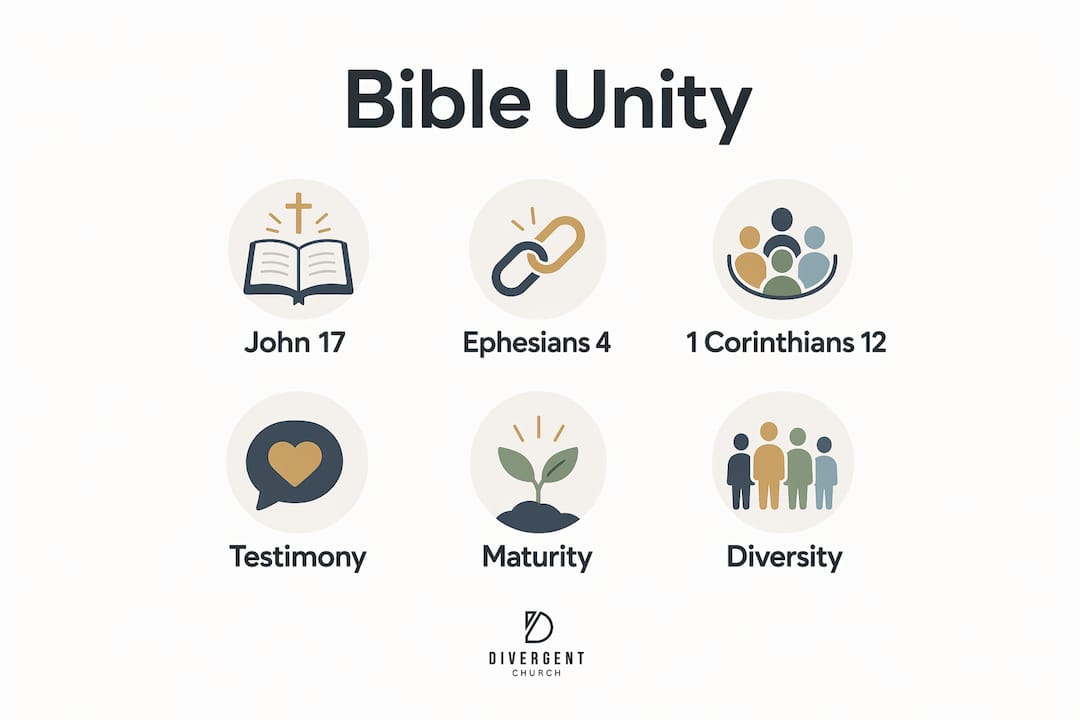
Pro Tip: When preaching or teaching on unity, anchor each session to one of these three passages rather than treating unity as a general theme. Each passage gives a different angle — missional (John 17), doctrinal (Ephesians 4), functional (1 Corinthians 12) — and together they cover the full biblical picture.
Unity is not the same as uniformity
This is the confusion that does the most damage in practice. Churches either pursue unity by ironing out every difference until everyone looks the same, or they abandon unity altogether because they assume difference makes it impossible. Both responses misread Scripture.
The distinction between primary and secondary doctrine is the key. Primary doctrines are those on which the gospel stands or falls: the deity and humanity of Christ, his atoning death and bodily resurrection, justification by grace through faith, the authority of Scripture. Unity requires agreement here. Secondary doctrines — baptism mode, eschatological timelines, worship style, church governance — are matters where genuine Christians have disagreed for centuries without either side departing from the gospel.
Concrete examples of what this looks like:
Two congregations with different worship styles (contemporary and liturgical) can share a prayer event, a food pantry, and a gospel witness without either abandoning its convictions.
A church that practises infant baptism and one that practises believer’s baptism can cooperate on city outreach while maintaining their own teaching on the matter.
A multicultural congregation in Canberra can hold together members from Korean, African, and Anglo-Australian backgrounds without requiring any one cultural expression to become the default.
Bad models of unity that fail the biblical test:
Sentimental unity: “We all love Jesus, so let’s never disagree.” This avoids conflict but also avoids truth, and it collapses the moment a real doctrinal question surfaces.
Gate-widening: Redefining the gospel to include more people by softening its claims. This is not generosity; it is a different gospel.
Forced agreement: Leadership pressure that silences legitimate theological questions. Unity built on suppression is fragile and breeds resentment.
The church diversity that Scripture envisions is not a liability. It is evidence that the gospel reaches across every human boundary.
Why does Christian unity matter so much?
The reasons are both theological and deeply practical, and neither category is optional.
It reflects the nature of God. The Trinity is the original community: Father, Son, and Spirit in perfect, self-giving love. When the church lives in genuine unity, it becomes a visible image of that divine life. This is not metaphor; it is the explicit logic of John 17.
It glorifies God before the watching world. Christian unity matters because it is a form of witness. When Christians from different backgrounds, cultures, and traditions love one another visibly, the world encounters something it cannot produce on its own terms.
It makes mission credible. A church fractured by internal conflict, public feuds, or denominational tribalism has a diminished voice in its community. The World Council of Churches, reflecting on its founding in 1948 after the devastation of the Second World War, identified Word and Witness as the two reasons unity is non-negotiable. The church’s proclamation and its common life must cohere.
It builds resilience and mutual care. Paul’s body metaphor in 1 Corinthians 12 is also a care metaphor: “If one part suffers, every part suffers with it.” A unified church is one where no member carries grief, illness, or hardship alone. That kind of community is rare and compelling.
It foreshadows the worship of heaven. Revelation pictures every tribe, tongue, people, and nation gathered before the throne. The unity the church practises now is a rehearsal for that eternal reality. The role of the church in society is partly to make that future visible in the present.
What disrupts unity, and how do you spot it early?
Division rarely arrives announced. It tends to grow from small, unaddressed fractures until the cost of repair feels too high. Knowing the common causes and early warning signs is half the battle.
Frequent causes of division:
Doctrinal drift, where secondary issues are gradually elevated to gospel-level importance
Personality-led leadership that creates loyalty to a person rather than to Christ and the community
Unrepentant sin that is protected rather than addressed through Matthew 18 processes
Cultural or political polarisation bleeding into church life, where political identity begins to shape theological identity rather than the reverse
Unresolved historical hurt that was never named, confessed, or forgiven
Red-flag indicators to watch for:
Factional language: “our group” versus “them,” or loyalty clusters forming around particular leaders or theological camps
Lack of accountability structures, where leaders are not subject to the same processes as members
Repeated patterns of hurt that are minimised or spiritualised rather than addressed
Avoidance of conflict dressed up as peacemaking — silence is not the same as peace
Initial steps to surface and contain conflict:
Name the fracture early, privately, and with care. Unspoken tension does not resolve itself.
Clarify whether the dispute is about primary doctrine, secondary doctrine, or personal preference. The response differs significantly.
Apply a Matthew 18 process: direct conversation first, then witnesses, then community accountability.
Seek restoration as the goal, not vindication.
Pro Tip: Keep a “primary/secondary/preference” grid visible in your leadership culture. When a new conflict surfaces, the first question is always: “Which category is this?” That single discipline prevents most secondary-doctrine disputes from being treated as gospel-level crises.
How can your church actively pursue unity?
Unity is a Spirit-given reality, but it is also a practice. The New Testament never treats it as automatic. Here are the steps that consistently appear in pastoral and theological literature as the means by which unity is nurtured and sustained.
Centre preaching and teaching on the gospel. When Christ is clearly and repeatedly the centre, secondary differences lose their power to divide. Scripture-shaped preaching is the single most important unity-forming habit a church has.
Practise shared catechesis. A congregation that learns the same doctrinal foundations together — the Apostles’ Creed, the Lord’s Prayer, the Ten Commandments — builds a common theological vocabulary that makes disagreement more navigable.
Maintain sacramental rhythms. Regular shared communion is a physical, embodied act of unity. It is hard to hold a grudge against someone you have just broken bread with.
Prioritise corporate prayer. Prayer in the life of the church is not merely devotional. When a congregation prays together for one another, for the city, and for the global church, it is practising the unity it is called to embody.
Cultivate hospitality. Shared meals, open homes, and genuine welcome across cultural and socioeconomic lines are among the most powerful unity-forming practices available to any congregation. They are also the hardest to fake.
Use a simple conflict-resolution process. Listen fully before responding. Clarify the actual point of disagreement. Apply Scripture to the specific situation. Pursue restoration, not just resolution.
Invest in healthy church relationships. Unity is not maintained in large gatherings alone; it is built in small groups, life communities, and one-on-one conversations where people are genuinely known.
Pro Tip: The most durable unity in a local church is built in small groups, not Sunday services. If your life groups are not intentionally crossing cultural, generational, or socioeconomic lines, your unity is probably more homogeneous than you realise.
How does ecumenism work in Australia?
Ecumenism is the pursuit of visible unity across denominational lines, and in Australia it takes several practical forms that churches can engage with safely and fruitfully.
Partnership type | What it involves | Theological guardrail |
Joint prayer events | City-wide prayer gatherings, Prayer for Christian Unity observances | Affirm shared gospel essentials before co-leading |
Social service projects | Food banks, refugee support, homelessness outreach | Cooperation on shared social witness; no doctrinal compromise required |
Bible study partnerships | Cross-denominational small groups studying Scripture together | Clarify which doctrines are primary and which are open for discussion |
Joint outreach | Evangelistic events, community festivals, Alpha courses | Ensure the gospel presented is agreed upon by all participating churches |
The Prayer for Christian Unity is observed annually, typically across an eight-day period in January, and draws Catholic, Orthodox, Anglican, and Protestant congregations into shared prayer. In Australia, the Archdiocese of Brisbane has been among the more active participants in ecumenical initiatives, hosting joint prayer services and cooperative social witness programmes that bring together churches across traditions.
What to watch for theologically in ecumenical settings:
Whether the gospel (the person and work of Christ, justification by faith) is being affirmed or quietly set aside for the sake of cooperation
Whether the partnership requires your congregation to misrepresent its own convictions
Whether the activity is one of shared witness or shared worship — the former is usually straightforward; the latter requires more careful discernment
Church partnerships for mission are most durable when they are built around a shared task rather than a shared statement of complete doctrinal agreement. Serving a community together creates trust that makes deeper theological conversation possible over time.
How does this look in Canberra?
Canberra is a city of transient populations, university students, public servants, and a genuinely multicultural community. That context shapes what unity looks like in practice.
At Divergentchurch, unity is pursued through life communities: small groups that cross generational, cultural, and vocational lines and meet in homes, cafes, and workplaces across the city. These groups are not homogeneous. They include people from different denominational backgrounds, different countries of origin, and different stages of faith. What holds them together is a shared commitment to Scripture and to Jesus, not a shared aesthetic or cultural preference.
Practically, other Australian churches can adapt this model by:
Forming life groups that intentionally include people from different cultural backgrounds, rather than allowing groups to self-select into homogeneity
Partnering with one other local congregation on a shared service project each year, building cross-church relationships through shared work
Observing the Prayer for Christian Unity period in January with a joint gathering or shared prayer resource
Teaching the primary/secondary/preference distinction explicitly in membership classes, so new members understand the church’s approach to disagreement from the start
The Canberra church unity work that Divergentchurch is part of is not a programme. It is a posture: staying curious about other Christians, staying humble about secondary convictions, and staying committed to the gospel as the ground on which all genuine unity stands.
Prayers and resources for practising unity
A short prayer for groups to open a unity-focused meeting:
Lord Jesus, you prayed that we would be one as you and the Father are one. We confess that we have allowed secondary things to divide us and pride to harden us. By your Spirit, soften our hearts toward one another. Give us the humility to bear with each other, the courage to speak truth in love, and the grace to pursue the unity you have already given us in Christ. Amen.
Study prompts for a life group or small group:
Read John 17:20–23. What does Jesus say is the purpose of unity among believers? How does that change the way you think about your relationships in this group?
Read Ephesians 4:1–6. What does Paul say we must “make every effort” to do? What does that effort look like in your church context?
Where have you experienced genuine Christian unity across denominational or cultural lines? What made it possible?
What is one secondary doctrine or preference that you have sometimes treated as a primary issue? What would it look like to hold it more loosely?
Read 1 Corinthians 12:12–27. Which part of the body metaphor most challenges the way your church currently functions?
For further study and group resources:
A practical study guide on biblical community living offers a structured way to work through the scriptural foundations of Christian community, including unity passages.
Short scripture study videos are a useful tool for life groups that want to engage key passages visually before discussion.
The Divergentchurch life communities resource includes meeting rhythms and study guides designed for groups pursuing authentic community in Canberra.
Corporate prayer rhythms that sustain unity are explored in depth on the Divergentchurch blog.
Key takeaways
Christian unity is a Spirit-given reality that churches are called to keep through gospel-centred teaching, shared prayer, honest conflict resolution, and humble cooperation across denominational lines.
Point | Details |
Unity is a gift, not an achievement | The Spirit creates oneness in Christ; the church’s task is to keep it, not manufacture it. |
Unity is not uniformity | Gospel essentials unite; worship style, secondary doctrine, and cultural expression are not grounds for division. |
Division harms witness | A fractured church undermines its own proclamation — John 17 ties unity directly to the world’s belief. |
Practical habits sustain unity | Shared prayer, catechesis, hospitality, and small-group life are the recurring means by which unity is nurtured. |
Divergentchurch in Canberra | Life communities and discipleship resources offer a local, practical way to pursue and practise Christian unity. |
Why unity is the most countercultural thing a church can do
There is a version of the unity conversation that stays safely theoretical: we agree unity is good, we cite John 17, and we move on. What is harder to sit with is the claim that genuine Christian unity is one of the most countercultural acts a church can perform in a city like Canberra.
The culture around us is extraordinarily good at sorting people into like-minded groups. Algorithms do it. Housing markets do it. Social networks do it. The result is communities that are deeply comfortable and deeply homogeneous. A church that genuinely crosses those lines — that holds together a Sudanese refugee and a public servant, a university student and a retiree, a charismatic and a Reformed believer — is not just being nice. It is making a theological statement about the power of the gospel to create a new kind of community.
What I find most compelling about the biblical vision is that it does not ask us to pretend differences do not exist. Paul does not say the foot becomes a hand. He says the foot is necessary precisely because it is a foot. The unity Scripture calls us to is not the unity of sameness; it is the unity of a body where every part is known, valued, and needed. That is a harder and more beautiful thing to build.
The temptation for any local church is to settle for the easier version: a community of people who already agree on most things, already share a cultural background, and already find each other comfortable. That is not the church Jesus prayed for. It is a club. The difference between a club and a church is whether the gospel is actually doing the work of bringing people together who would not otherwise choose each other.
Divergentchurch: a local community shaped by unity
If this article has stirred something in you — a desire to pursue genuine community, to find a church where the gospel is central and difference is welcomed — Divergentchurch in Canberra is a place worth exploring.
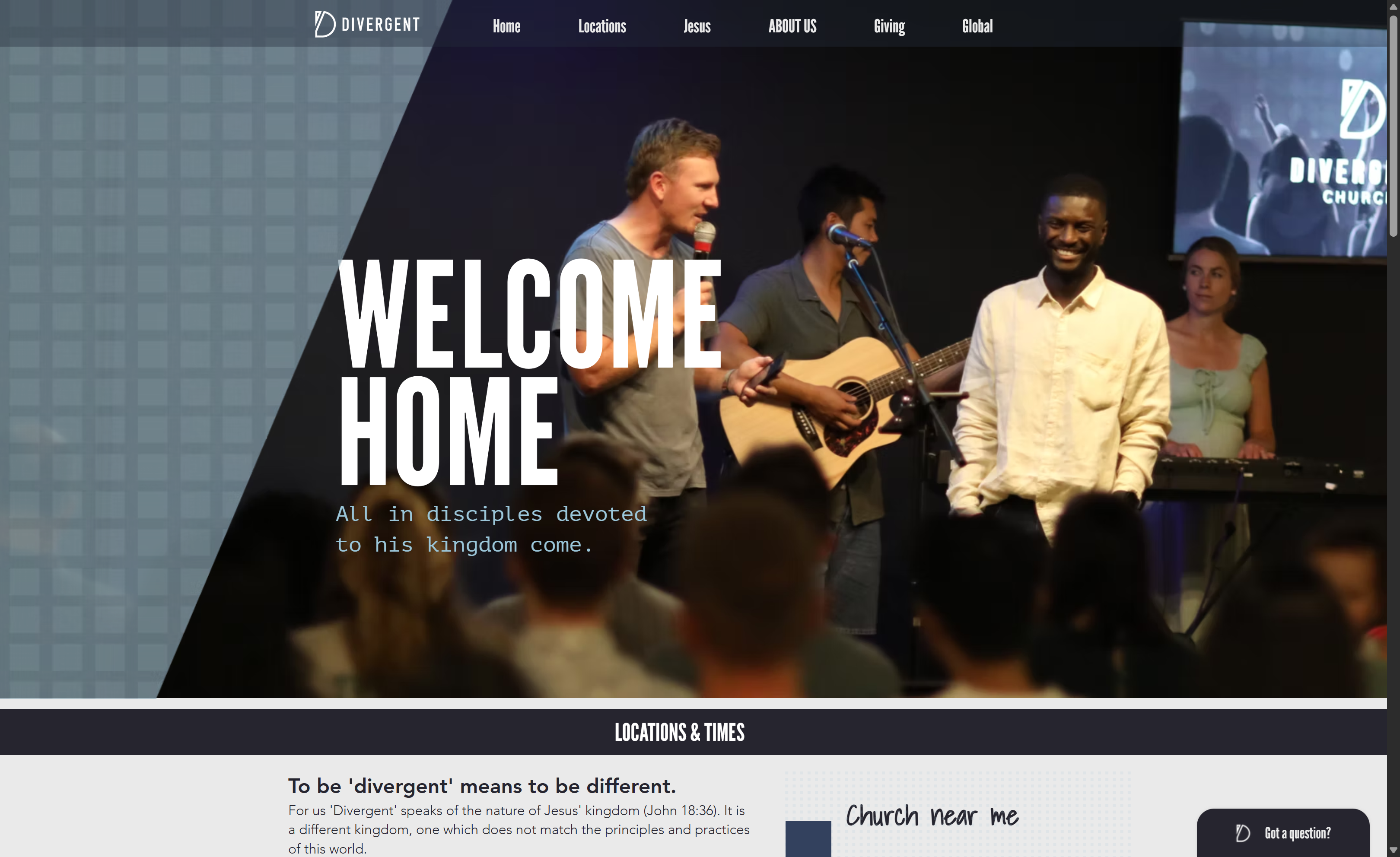
Divergentchurch is not a programme or a Sunday event. It is a community of disciples shaped by Scripture, centred on Jesus, and expressed through everyday life across Canberra and Queanbeyan. Life communities are the heartbeat of that: small groups meeting in homes and workplaces, crossing cultural and generational lines, practising the kind of unity this article describes. The Discipleship Hub offers resources for anyone wanting to go deeper in faith and community, and the Life Communities page is the natural next step for anyone ready to find their people. Come and see what it looks like when the gospel actually holds a community together.
Useful sources and further reading
What is the importance of Christian unity? | GotQuestions.org — A clear, scripture-grounded overview of why unity matters, including the limits of unity where gospel truth is denied. Useful for foundational reading on John 17 and church discipline.
What Is Christian Unity? | Desiring God — Pastoral and theological treatment of unity’s spiritual depth, with practical application for church life. Strong on the spiritual disciplines that sustain unity.
What Is Unity in the Bible? | Renew.org — Exegetical treatment of Ephesians 4 and the scope of biblical unity, including context on global denominational fragmentation.
Christian unity is deeper than ‘getting along’ | The Gospel Coalition — Trevin Wax’s corrective against sentimental views of unity; argues that genuine unity participates in the life of the Trinity.
What Christian Unity Is, and What It Isn’t | Outreach Magazine — Practical pastoral guidance on the unity/uniformity distinction, with examples from church leadership.
Do we need Christian unity? | World Council of Churches — The WCC’s theological and missional case for unity, grounded in John 17 and the church’s witness to the world. Australian churches engaging in ecumenical work will find this a useful reference.
Christian unity | Ligonier — Short devotional treatment of 1 Corinthians 12 and the body metaphor; accessible for small-group use.
Recommended
Comments