
How to cultivate church relationships that truly last


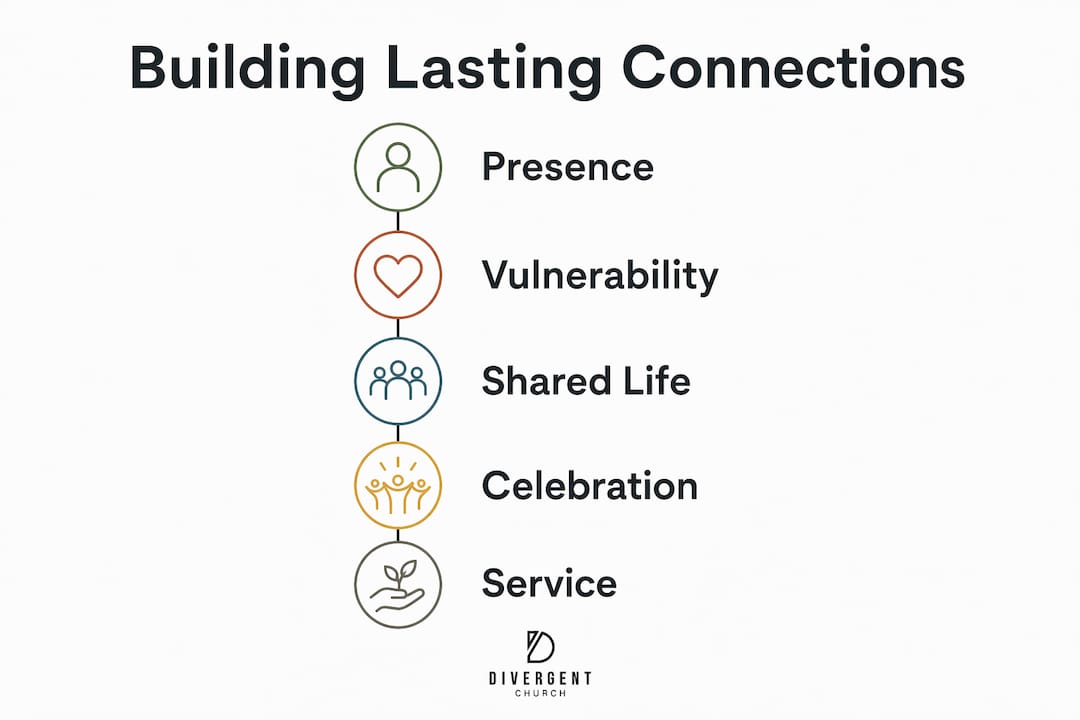
Strong church relationships don’t happen by accident. They grow through intentional presence, shared vulnerability, and rhythms of life lived together, grounded in the truth that we were made for one another. As Paul writes in Romans 12:5, “so in Christ we, though many, form one body, and each member belongs to all the others.” That belonging is not a programme to attend. It is a way of life to inhabit.
Here is what actually works when you want to build church community that goes deeper than Sunday morning:
Show up consistently. Presence over time is the soil in which trust grows. Attend not just services but the ordinary moments: the shared meal, the prayer circle, the coffee after church.
Pray together. Praying with someone, not just for them, is one of the fastest paths to genuine intimacy. Stop mid-conversation and ask, “Can I pray with you right now?” Few people will say no.
Celebrate and grieve together. Acknowledge births, marriages, losses, and hardships within your community. Shared joy deepens bonds; shared sorrow deepens them further.
Listen actively. Put the phone down. Make eye contact. Listen to understand, not to respond.
Create space for others. Hospitality, in the biblical sense, is not entertaining. It is opening your life to people who need to belong.
Stay, even when it is hard. Those who stay grow. Stability is one of the most underappreciated elements of a thriving spiritual life.
Table of Contents
1. Why doing life together is the foundation of church community
2. Leadership qualities that shape a culture of authentic connection
3. How celebrating life milestones strengthens your church bonds
5. How Divergentchurch lives out biblical community in Canberra
6. Practical communication and active listening in church relationships
7. Encouraging mutual service and support among church members
8. Navigating generational differences to strengthen intergenerational bonds
Divergentchurch: a community where you are known, not just counted
1. Why doing life together is the foundation of church community
Real connection rarely happens in a sanctuary with everyone looking at the back of someone else’s head. It happens on a Tuesday evening around a kitchen table, or on a Saturday morning walk, or in the car park after service when someone finally says what they have been carrying all week.
Community does not form automatically. It requires vulnerability, consistency, and shared purpose, three things a Sunday service alone cannot easily provide. Vulnerability needs a smaller, safer space. Consistency requires rhythms outside a weekly hour. Shared purpose means doing something together, not just sitting together.
The shift from programme-heavy church life to rhythm-based relational engagement is not about doing less. It is about doing what you already do with more intentionality. A weekly walking group, a monthly shared meal, a standing coffee catch-up: these low-pressure rhythms weave connection into the fabric of daily life far more durably than a packed events calendar.
Pro Tip: Prioritise presence over performance after each service. The fifteen minutes following the benediction are some of the most important relational moments of the week. Stay in the lobby. Greet people by name. Ask about their lives outside church. Connection happens in the hallways, not just the pews.
2. Leadership qualities that shape a culture of authentic connection
The culture of a church almost always reflects the character of its leaders. Where leaders are humble, curious, and genuinely present, the congregation tends to follow. Where leaders perform rather than participate, people remain spectators.

Leadership humility, gratitude, and vulnerability create an emotionally safe environment where church members can authentically connect. When a leader is willing to be real about their own struggles, it gives the whole community permission to take off their masks.
Practical leadership habits that build relational depth:
Name people, not just roles. Know who someone is beyond their volunteer slot.
Model curiosity. Ask about people’s stories, their week, their fears. Curiosity is the antidote to judgment, creating space for people to belong before they have everything figured out.
Protect the absent. How you speak about people when they are not in the room tells everyone else how they will be spoken of when they leave.
Empower natural gatherers. Every congregation has people who organically bring others together. Identify and empower these connectors rather than centralising all community-building in staff roles.
Shift from attendance tracking to presence cultivation. The question is not “How many came?” but “Who felt known?”
3. How celebrating life milestones strengthens your church bonds
One of the most overlooked ways to cultivate church connections is simply showing up for the moments that matter most in people’s lives. A new baby. A wedding. A cancer diagnosis. A redundancy. A graduation. These are the moments when people discover whether their church is a community or just a crowd.
Celebrating life milestones within the congregation strengthens relational bonds by expressing care that goes beyond Sunday morning. Shared celebrations and shared sorrows both build trust, because they reveal that people matter to one another beyond what they contribute to the programme.
Ways to honour milestones with genuine care:
Acknowledge births, engagements, and marriages publicly and personally.
Organise meals for families navigating illness, loss, or major transitions.
Send handwritten notes during difficult seasons. A card during a hard week lands differently than a text.
Create space in services to pray specifically for members facing significant life events.
Be culturally sensitive. In a diverse Australian church context, milestone observances vary across cultural backgrounds. Ask before assuming what a family wants or needs.
Inclusion matters here. Not every milestone looks the same across generations, cultures, or family structures. The goal is not a uniform response but a genuinely attentive one, shaped by knowing the person in front of you.
4. How small groups help you build belonging beyond Sunday
Large gatherings are wonderful for worship and teaching, but they are not where most people feel personally known. Intimacy in larger churches is possible through intentional decentralisation into smaller, consistent groups, whether neighbourhood clusters, affinity teams, or life communities meeting in homes.

Small groups and life communities are where the “one anothers” of Scripture actually happen: bearing one another’s burdens, confessing to one another, praying for one another. These are not abstract commands. They require a space small enough for people to be honest.
Best practices for small groups that genuinely build belonging:
Keep groups small enough that everyone can speak and be heard, typically eight to twelve people.
Prioritise sharing and prayer over content delivery. A video series is a starting point, not the destination.
Open new entry points regularly. Rotate memberships, mix seating at shared meals, and create short-term serving teams that bring together people who would not normally connect.
Name the clique dynamic honestly. If a group has not welcomed anyone new in a year, it may have become a closed loop rather than a community.
Make space for introverts. Not everyone needs to speak to belong. Shared activities, gardening, cooking, walking, allow connection to happen naturally.
For adults navigating how to find their place in a group, small group meetups for friendship offer practical guidance on building sustainable bonds in community settings.
5. How Divergentchurch lives out biblical community in Canberra
Divergentchurch in Canberra is not simply a Sunday gathering. It is a community shaped by Scripture, centred on Jesus, and expressed through everyday life, relationships, and mission across the city’s universities, workplaces, and neighbourhoods.
The rhythms that Divergentchurch models draw directly from Acts 2:42, where the early church devoted themselves to the apostles’ teaching, fellowship, breaking bread, and prayer. These are not programmes bolted onto a Sunday service. They are the connective tissue of a community that does life together across the week.
Pro Tip: If you are part of a church in a transient city like Canberra, where students and public servants move frequently, build relational rhythms that do not depend on long-term residency. Short-term depth is still depth. Welcome people into community quickly, and send them well when they go.
Practical applications from Divergentchurch’s local context:
Centre community on biblical teaching, not just social connection. Shared Scripture gives relationships a shared foundation.
Break bread together regularly. The table is a sacramental space where guards come down and stories spill out.
Pray together as a community rhythm, not just a programme element.
Engage the city. Divergentchurch exists within Canberra’s rhythms, not apart from them. Building strong community means showing up in the city’s life, not just inviting the city into your building.
6. Practical communication and active listening in church relationships
Genuine connection requires more than proximity. It requires the willingness to communicate honestly and to listen in a way that makes the other person feel truly heard.
Active listening is not passive. It means resisting the urge to mentally compose your response while someone is still speaking. It means staying in the room when someone shares something raw, rather than rushing to fix it or spiritualise it. It means acknowledging a fear or a failure without immediately wrapping it in a lesson.
A few practices that make a real difference:
Ask open questions. “How are you actually going?” opens more than “How are you?” Specificity invites honesty.
Reflect back what you hear. “It sounds like you’re carrying a lot right now” tells someone they have been understood, not just heard.
Validate before advising. Emotions dismissed quickly do not disappear. They just go underground.
Follow up. If someone shared something difficult last week, ask about it this week. Remembering what people tell you is one of the most powerful acts of care.
True belonging occurs when people feel safe to be emotionally real, valued for their whole person, including their doubts and struggles, not just their Sunday-best version. Communication that creates that safety is not a soft skill. It is a spiritual discipline.
7. Encouraging mutual service and support among church members
A church where only the staff serve and the congregation consumes will never feel like a family. Paul’s image of the body in 1 Corinthians 12 is instructive: every part has a function. No one is just an appendage waiting to be needed.
The shift from “How can the church serve you?” to “What has God placed in your hands to offer?” changes everything. When people contribute, they root themselves. They stop evaluating the church from a distance and start belonging to it.
Practical ways to encourage mutual service:
Invite newcomers to contribute early. If someone has a gift for music or a heart for prayer, find a way to let them use it within existing structures rather than waiting until they have “settled in.”
Create a simple directory of skills and needs within your community. A retired tradesperson who does not know about a family’s urgent need cannot help. Connection of needs to gifts requires intentional infrastructure.
Pair spiritually mature members with those newer to faith for organic, one-on-one mentorship. This is not a formal programme. It is a friendship with purpose.
Celebrate acts of service publicly. When the congregation sees members caring for one another, it normalises and multiplies that culture.
Ownership replaces observation when people are genuinely needed. That shift, from spectator to participant, is where church unity takes root and holds.
8. Navigating generational differences to strengthen intergenerational bonds
One of the richest and most underused resources in any local church is the breadth of its generations. The wisdom of those who have walked with God for decades, and the energy and questions of those just beginning, belong together. But they do not automatically connect.
Generational differences in communication style, cultural reference, and expectations around church life are real. A 22-year-old university student and a 68-year-old retiree may both love Jesus and feel completely invisible to each other on a Sunday morning.
Intentional intergenerational connection requires structure:
Create shared serving opportunities that mix age groups around a common task rather than separating them into age-specific programmes.
Encourage mentorship across generations. Older members taking a younger person for coffee once a month builds a relational safety net that no programme can replicate.
Design small groups with age diversity in mind. A group that spans the 30s to 60s, as one Woodland Hills Church community discovered, brings a richness that a homogenous group rarely achieves.
Name generational assumptions from the front. Leaders who acknowledge that different generations experience church differently give everyone permission to be honest about what they need.
For young adults specifically, finding your place in church as a young adult in a city like Canberra involves moving beyond mere attendance toward genuine participation. That move is easier when older members actively make room for it. And for those connecting with a spiritual community that genuinely fits, intergenerational depth is often one of the clearest markers of a healthy church.
Key takeaways
Authentic church relationships grow through consistent presence, shared life rhythms, and the courage to be known, not through more programmes or bigger events.
Point | Details |
Presence over programmes | Prioritising consistent presence and connection creates stronger bonds than adding more events to the calendar. |
Prayer as relational foundation | Praying together, not just for one another, is one of the fastest paths to genuine intimacy in church relationships. |
Small groups create belonging | Intentional decentralisation into smaller, consistent groups allows every person to be personally known and pastorally cared for. |
Milestones matter | Acknowledging births, losses, marriages, and hardships within the congregation builds the trust that Sunday attendance alone cannot. |
Divergentchurch in Canberra | Divergentchurch models biblical community through teaching, fellowship, shared meals, and prayer woven into everyday city life. |
Divergentchurch: a community where you are known, not just counted
If you have read this far, you are not looking for a bigger crowd. You are looking for a community where you are genuinely known, where your presence is felt when you are absent, and where faith is lived out across the whole week, not just Sunday morning.
Divergentchurch in Canberra is built around exactly that vision. Shaped by Scripture and centred on Jesus, the community gathers not just for services but for shared meals, prayer, and the ordinary moments of city life. Life Communities at Divergentchurch are the heartbeat of that relational depth: smaller groups meeting in homes and across Canberra’s neighbourhoods, where vulnerability is welcomed and no one stays anonymous.
Whether you are new to faith, returning after time away, or simply ready to go deeper than Sunday morning, Divergentchurch has a place for you. Explore Life Communities to find a group near you, or visit the Discipleship Hub to take your next step in faith and community.
Recommended
Comments