
Multicultural Church Canberra: find your community
- Josh

- Jun 4
- 8 min read
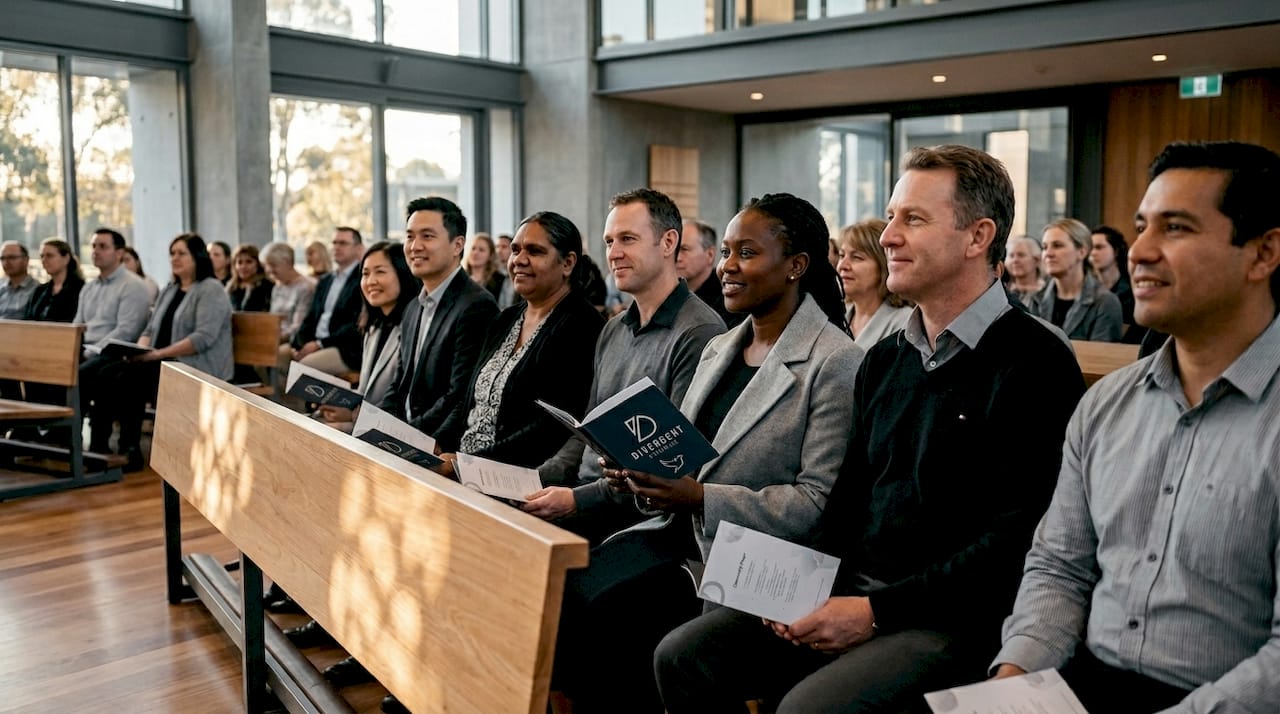
A multicultural church in Canberra is a Christian fellowship where people from varied cultural backgrounds worship together in an inclusive, welcoming environment that celebrates diversity as a gift rather than a challenge. Canberra is one of Australia’s most culturally layered cities, shaped by diplomats, international students, refugees, and long-term residents from dozens of nations. The 2026 National Multicultural Festival drew over 350,000 visitors, with 94% agreeing Canberra genuinely values diversity. Churches like Divergent Church and International Church Canberra sit at the heart of that story, offering something the festival cannot: a community you belong to every week of the year.
What makes a church multicultural in Canberra?
A multicultural church, sometimes called an intercultural or cross-cultural congregation, is defined by three core characteristics: cultural inclusivity in its membership, multilingual or culturally adaptive worship, and ministries designed to serve people across ethnic and linguistic backgrounds. These are not cosmetic features. They shape the theology, the pastoral care, and the rhythms of weekly life together.
Canberra’s context makes this especially significant. The city’s cultural diversity is not accidental. It reflects decades of government policy, university growth, and diplomatic presence. The ACT Government’s targeted funding for cultural events and community organisations has created a city where cultural difference is publicly celebrated. A church that mirrors that reality is not simply being trendy. It is being faithful to the city it serves.
The defining features of a genuinely multicultural faith community include:
Multilingual services or translation support, so non-English speakers can engage fully with worship and teaching
Diverse worship styles, drawing from African, Asian, Pacific, and Western Christian traditions
Culturally sensitive pastoral care, where leaders understand the specific pressures facing migrants, international students, and refugees
Intentional community programming, including cultural celebrations, shared meals, and language support groups
Pro Tip: When visiting a church for the first time, ask whether they have small groups or life communities that reflect cultural diversity. A Sunday service can look multicultural while the relational core remains monocultural.
The multilingual services and cultural celebrations offered by churches like Divergent Church are not add-ons. They are expressions of a theological conviction: that the body of Christ is most fully itself when it reflects every tribe, tongue, and nation.
How do multicultural churches support spiritual growth?
Spiritual growth in a multicultural church happens through connection, not just content. When you sit beside someone whose faith was forged in a different country, under different pressures, and expressed in a different language, your own understanding of God expands. That is not a sentiment. It is a documented pattern in how diverse Christian communities function.

Divergent Church’s Discipleship Hub and Life Communities are built on this principle. Discipleship pathways are designed to be accessible regardless of cultural background or language proficiency, with small groups that prioritise relationship over programme. This matters because spiritual growth is relational before it is instructional.
The social benefits run alongside the spiritual ones. Multicultural churches provide rich community activities beyond Sunday worship, including cultural celebrations, volunteer opportunities, and language support groups. For a newly arrived family from the Philippines, a student from South Korea, or a professional from Nigeria, these activities are often the first genuine point of belonging in a new city.
Theologian Michael Jensen describes the church as a social laboratory for unity, a community that practises “domesticating disagreement into friendship.” That phrase is worth sitting with. In a world that sorts people by algorithm and ideology, a church that holds together people of genuinely different backgrounds is doing something countercultural and prophetic.
The practical shape of this in Canberra looks like:
Small groups organised around neighbourhood or life stage rather than ethnicity, so cultural mixing happens naturally
Discipleship programmes that acknowledge different starting points in faith and cultural familiarity with Christianity
Newcomer-friendly events that lower the barrier to entry for people unfamiliar with church culture
Pastoral care that is sensitive to the specific vulnerabilities of migrants, international students, and those navigating grief or displacement far from home
Multicultural vs monocultural churches: what is the difference?
Understanding how multicultural churches differ from traditional monocultural congregations helps you make a more informed choice about where to plant yourself spiritually. The differences are real and worth naming honestly.
A monocultural church is not necessarily unwelcoming. Many are warm, faithful communities. But their membership, worship style, and cultural assumptions tend to reflect a single ethnic or national background. Sermons, music, and social norms are shaped by that dominant culture, which can make people from other backgrounds feel like guests rather than members.
Multicultural churches differ in that inclusivity and diversity are structural commitments, not aspirational values. The table below captures the key contrasts:
Feature | Multicultural church | Monocultural church |
Membership composition | Intentionally cross-cultural | Predominantly one ethnicity or nationality |
Worship style | Draws from multiple cultural traditions | Reflects one dominant cultural tradition |
Language options | Multilingual or translation-supported | Primarily one language |
Pastoral care | Culturally sensitive and adaptive | May not address cross-cultural needs |
Community programming | Cultural celebrations, diverse events | Events shaped by one cultural calendar |
Spiritual approach | Intercultural discipleship pathways | Single-culture discipleship model |
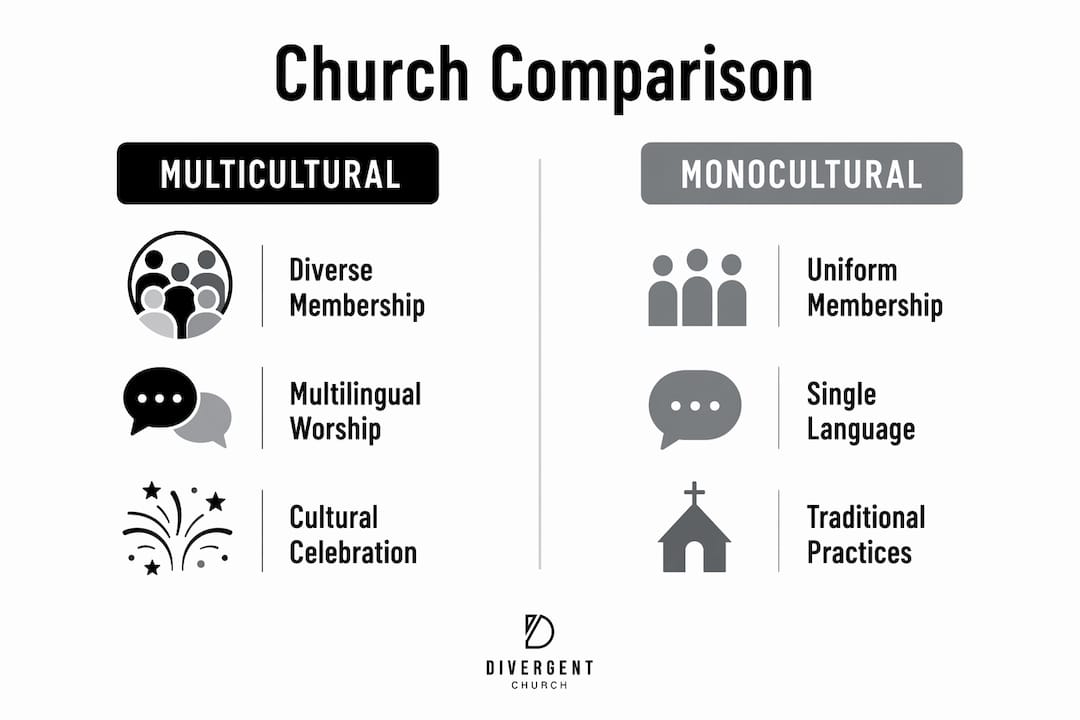
The advantages of a multicultural church are significant for Canberra’s transient population. When you move cities or countries, a church that already knows how to welcome the unfamiliar is a different kind of gift. The challenges are equally real: navigating cultural misunderstandings, holding together different expectations about worship, and building genuine trust across language barriers all require intentional leadership. Churches that do this well, like Divergent Church, invest heavily in relational infrastructure rather than just programming.
Community feedback from attendees consistently highlights the welcoming atmosphere and cultural celebration as the defining features that keep people coming back. That is not a marketing claim. It is what people say when asked why they stayed.
How to find and join a multicultural church in Canberra
Finding a genuinely multicultural church in Canberra requires more than a Google search. It requires showing up, asking honest questions, and giving a community enough time to reveal its actual culture rather than its curated first impression.
Here is a practical pathway:
Search with specificity. Look for churches that explicitly describe themselves as intercultural, international, or multicultural. Divergent Church’s international church page is a good starting point for understanding what that commitment looks like in practice.
Attend community events first. The National Multicultural Festival and local ACT community events often feature church-run stalls and activities. These are low-pressure ways to meet people from faith communities before committing to a Sunday service.
Ask about small groups. A church’s small group structure reveals more about its actual culture than its Sunday service. Ask whether Life Communities or equivalent groups reflect cultural diversity in their membership.
Look for newcomer support. Multicultural churches actively encourage new attendees to participate regardless of language proficiency or cultural background. If a church has no visible pathway for newcomers, that tells you something important.
Engage with discipleship pathways. Spiritual growth requires more than attendance. Ask whether the church has structured discipleship programmes that are accessible across cultural and linguistic backgrounds.
Pro Tip: Visit on a non-Sunday occasion first. Mid-week events, community meals, or volunteer days reveal the relational texture of a church far more honestly than a polished Sunday service.
The ACT Government’s investment in community-led cultural efforts confirms that Canberra’s multicultural identity is sustained by grassroots participation, not just policy. The same is true of multicultural churches. They are built by people who choose to show up across difference, week after week.
Key takeaways
A multicultural church in Canberra is defined by structural commitments to cultural inclusivity, multilingual worship, and cross-cultural discipleship, not by demographic aspiration alone.
Point | Details |
Definition matters | A multicultural church is structurally inclusive, not just demographically mixed. |
Canberra’s context | With 94% of festival visitors affirming the city values diversity, churches that reflect this are meeting a genuine community need. |
Spiritual growth is relational | Discipleship programmes like Divergent Church’s Discipleship Hub are built for cross-cultural accessibility. |
Practical involvement | Joining small groups and attending newcomer events reveals a church’s actual culture more than Sunday services alone. |
The church as social laboratory | Multicultural churches model reconciliation and belonging in ways that extend well beyond Sunday worship. |
Why I believe multicultural churches are Canberra’s most underrated community asset
I have spent years watching people arrive in Canberra, full of hope and quietly terrified of loneliness. Diplomats, students, refugees, skilled migrants. They find the city beautiful and the social fabric harder to enter than they expected. Canberra is polite but not always warm. Professional but not always relational.
What strikes me about genuinely multicultural churches is that they solve a problem most institutions cannot even name. They create belonging across difference without requiring people to abandon who they are. That is not a small thing. It is, in fact, a prophetic act in a city where social networks tend to form along professional and ethnic lines.
The challenge I see in 2026 is that many churches describe themselves as multicultural without doing the structural work. Diversity on a stage is not the same as diversity in leadership, pastoral care, and discipleship design. The churches that will matter most to Canberra’s future are the ones willing to be genuinely changed by the cultures they welcome, not just enriched by their presence.
Divergent Church’s commitment to forming disciples across cultural lines, through Life Communities, the Discipleship Hub, and everyday relational mission, is the kind of model worth paying attention to. Seeds planted in genuine welcome grow into something the city needs more of.
— Josh
Grow in faith at Divergent Church Canberra
Divergent Church is a Christian community in Canberra built for people who are serious about faith and serious about belonging. Whether you are new to the city, new to Christianity, or simply looking for a church that reflects Canberra’s genuine cultural diversity, Divergent Church offers a real pathway forward. The Discipleship Hub provides structured spiritual growth programmes accessible across cultural and linguistic backgrounds. Life Communities are small groups designed for genuine relationship, not just attendance. If you are ready to follow Jesus within a community that looks like the city you live in, Divergent Church is worth your time.
FAQ
What is a multicultural church?
A multicultural church is a Christian congregation that intentionally welcomes people from diverse cultural, ethnic, and linguistic backgrounds, offering inclusive worship, multilingual support, and culturally sensitive pastoral care. It is defined by structural commitment to diversity, not simply by having a mixed congregation.
Are there multicultural churches in Canberra?
Yes. Canberra has several multicultural faith communities, including Divergent Church and International Church Canberra, which offer diverse worship styles, cross-cultural small groups, and discipleship programmes designed for people from varied backgrounds.
How do I know if a church is genuinely multicultural?
Look beyond the Sunday service. A genuinely multicultural church has diverse leadership, multilingual or translation-supported worship, culturally sensitive pastoral care, and small groups that reflect the breadth of its congregation rather than a single dominant culture.
What are the benefits of joining a multicultural church in Canberra?
Joining a multicultural faith community offers spiritual growth through cross-cultural connection, practical support for newcomers and migrants, and a sense of belonging that reflects Canberra’s broader cultural identity. Programmes like Divergent Church’s Discipleship Hub are specifically designed to be accessible across cultural backgrounds.
How does Canberra’s cultural diversity shape its church communities?
Canberra’s identity as a diplomatic, university, and government city creates a transient, internationally diverse population. With over 94% of attendees at the 2026 National Multicultural Festival affirming the city values diversity, churches that reflect this reality are meeting a genuine and growing community need.
Recommended
Comments