
The role of leadership in church: a 2026 guide
- Josh

- Jul 5
- 7 min read

The role of leadership in church is to humbly serve and influence the congregation toward spiritual growth and community transformation. Church leadership, understood through the lens of servant leadership, is not about positional authority or control. It is about forming disciples, nurturing community, and equipping people to live out their faith in everyday life. Research published in march 2026 confirms that servant leadership is the most effective factor for achieving spiritual health and sustainable ministry. At Divergentchurch in Canberra, this conviction shapes everything, from how leaders are chosen to how the whole community is formed.
What are the core leadership roles in a church?
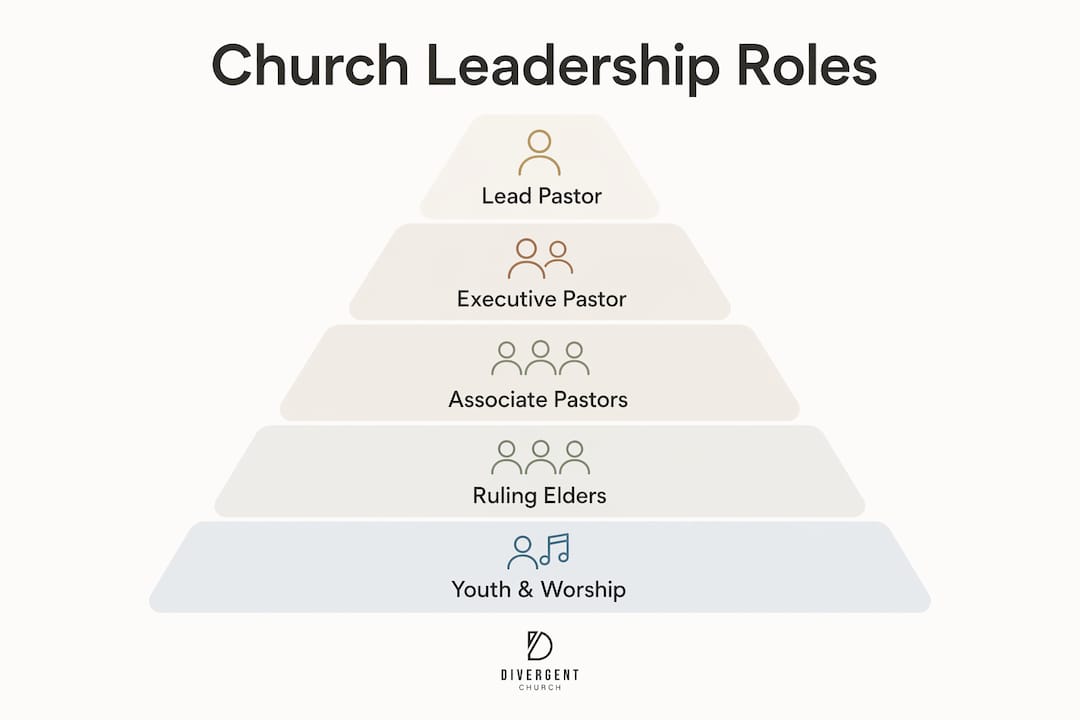
Common church leadership roles include Lead Pastors, Executive Pastors, Associate Pastors, Ruling Elders, and specific ministry leaders for areas like youth and worship. Each role exists to distribute the ministry burden and promote genuine shepherding across the congregation. No single leader can carry the full weight of a healthy church alone.
The Lead or Senior Pastor holds primary responsibility for preaching, vision, and spiritual direction. The Executive Pastor typically manages operations and staff, freeing the Lead Pastor to focus on teaching and pastoral care. Associate Pastors serve specific communities within the church, such as families, young adults, or those in crisis.

Ruling Elders occupy a distinct and often misunderstood role. The Presbyterian Church (U.S.A.) describes ruling elders as nurturers, using a “measuring tape” metaphor to describe their work of assessing spiritual health rather than enforcing compliance. This framing matters because it shifts the elder’s posture from authority figure to caring shepherd.
Youth and Worship Leaders round out the team by shaping the spiritual formation of specific groups and the gathered worship experience. Their influence is significant because they often have the most consistent weekly contact with congregants.
Here is a summary of how these roles function together:
Role | Primary Function |
Lead/Senior Pastor | Preaching, vision, and overall spiritual direction |
Executive Pastor | Operations, staff management, and ministry coordination |
Associate Pastor | Pastoral care for specific communities or demographics |
Ruling Elder | Spiritual health assessment and congregational nurture |
Youth and Worship Leaders | Formation and engagement for specific groups |
Lead Pastor: Sets the theological and missional direction of the church.
Executive Pastor: Keeps the organisation functioning so ministry can flourish.
Associate Pastors: Provide relational depth and targeted pastoral care.
Ruling Elders: Guard the spiritual health of the congregation with gentleness.
Youth and Worship Leaders: Shape the faith of the next generation and the gathered community.
How does servant leadership shape leadership influence in church?
Servant leadership is the model where the leader’s primary goal is the growth and wellbeing of those they lead, not the accumulation of influence or authority. It stands in direct contrast to dominance-driven or charismatic leadership styles that prioritise the leader’s vision over the congregation’s formation. The difference is not subtle. It reshapes every interaction, decision, and structure within a church.
Jesus modelled this most clearly. He washed his disciples’ feet, ate with the marginalised, and described his own mission as coming “not to be served, but to serve” (Mark 10:45). Paul echoed this in his letters, describing himself as a servant of the churches rather than their master. Ezra modelled it through patient teaching and communal repentance rather than top-down decree.
Servant leadership builds trust and voluntary participation, strengthening ministry through valuing and equipping others rather than controlling them. When leaders serve first, congregants engage more deeply, give more generously, and stay more faithfully.
Research from february 2026 confirms that servant leadership builds trust and voluntary participation in ways that authority-based models cannot replicate. That finding aligns with what pastors and elders observe on the ground: people follow leaders they trust, not leaders they fear.
Charismatic or dominance-driven leadership can produce short-term growth. However, dominance-driven leadership harms long-term spiritual formation and erodes trust within the community. The congregation may grow in numbers while shrinking in depth. That is a trade-off no faithful leader should accept.
Pro Tip: If you want to assess your own leadership posture, ask yourself this: when a decision is made, does it protect your position or empower your people? The answer reveals more than any leadership assessment tool.
Understanding how to connect with a spiritual community that embodies these values is a practical first step for anyone seeking a church shaped by genuine servant leadership.
What character qualities are essential for effective spiritual leadership?
Spiritual leadership effectiveness depends on character, not competence alone. A leader may be gifted in preaching or administration, but without consistent, visible, blameless character, their influence will eventually collapse. May 2026 guidance on Acts 20:28 states that spiritual leaders must be present and of blameless character over time. Distant or “behind closed doors” leadership risks ministry failure.
The qualities that matter most are not dramatic. They are daily.
Humility. Leaders who view their role as service rather than power build authentic followership. Pride is not just a personal flaw in a leader. It fractures community and distorts the gospel message.
Consistency. Congregants need to see the same person on Sunday and on Tuesday. Inconsistency between public and private behaviour destroys credibility faster than any public failure.
Presence. Visible, relational involvement among congregants is not optional. Leaders who retreat into administration and away from people lose their pastoral influence.
Teachability. A leader who stops learning stops leading. Teachability signals to the congregation that growth is valued, not just expected of others.
Reputation. Paul’s instructions to Timothy and Titus both emphasise that leaders must be “above reproach” in their families and communities. A leader’s home life is not private. It is a testimony.
The danger of pride deserves particular attention. Church leadership authority should be exercised as protection and care, not control. When leaders conflate organisational authority with spiritual authority, they centralise power rather than equip others. That pattern produces dependency, not discipleship.
Pro Tip: Regularly invite honest feedback from two or three trusted people in your congregation. Not flattery. Honest observation. The leaders who do this consistently are the ones who last.
How do church leaders facilitate growth without claiming undue credit?
The most theologically grounded and practically freeing insight in church leadership is this: leaders do not cause growth. God does. Paul states it plainly in 1 Corinthians 3:6, “I planted, Apollos watered, but God gave the growth.” This is not false modesty. It is an accurate description of how spiritual formation works.
March 2026 reflections describe leaders as “unskilled helpers” who plant and water but must acknowledge that God causes growth. That framing protects leaders from pride and protects congregations from unhealthy dependence on a single personality.
What does this look like in practice?
Plant faithfully. Preach the Word, create space for community, and build structures that support discipleship. These are the seeds.
Water consistently. Pastoral care, prayer, and relational presence keep the conditions right for growth. This is the ongoing work.
Release the outcome. When a congregation grows, resist the temptation to take credit. When it struggles, resist the temptation to take all the blame. Both responses misunderstand the leader’s actual role.
Celebrate God’s work. Point the congregation toward what God is doing, not what the leadership team has achieved. This shapes a culture of gratitude rather than performance.
Personal insignificance in leadership fosters joy and humility that enhance influence, contrasting with pride which inhibits relational ministry growth. Leaders who genuinely believe they are servants of God’s process are freer, more joyful, and more effective than those who carry the weight of outcomes they were never meant to control.
The importance of church leaders serving from this posture cannot be overstated. It shapes the entire culture of a congregation, from how volunteers are thanked to how setbacks are processed.
Key takeaways
Effective church leadership is servant-oriented influence that equips the congregation, distributes ministry across defined roles, and trusts God for growth rather than claiming credit for outcomes.
Point | Details |
Servant leadership drives health | Research confirms servant leadership is the most effective factor for spiritual health and sustainable ministry. |
Roles distribute the burden | Defined roles like Lead Pastor, Ruling Elder, and Youth Leader prevent burnout and promote genuine shepherding. |
Character precedes competence | Humility, presence, and consistency are the non-negotiable foundations of lasting leadership influence. |
Leaders plant and water only | God causes growth; leaders who accept this are freer, more joyful, and more effective. |
Authority serves, not controls | Church authority exercised as care and protection builds trust; authority exercised as control erodes it. |
Leadership is the soil, not the seed
After years of observing and participating in church leadership, the pattern I keep returning to is this: the healthiest churches are led by people who seem almost surprised by the growth around them. Not because they are passive, but because they genuinely believe they are not the point.
The leaders I have seen cause the most damage are not the ones who failed publicly. They are the ones who quietly centralised everything, who made themselves indispensable, and who confused the congregation’s loyalty to them with loyalty to Christ. That confusion is slow-acting and devastating.
What I have found actually works is a combination of clear role definition, relentless humility, and a willingness to be genuinely present with people, not just present on a stage. The leadership approach at Divergentchurch reflects this. It is not about building a platform. It is about building people.
The most freeing thing a leader can do is accept that they are the soil preparation crew, not the seed. God plants something in a person’s life long before a leader shows up, and it keeps growing long after. Your job is to create the conditions. Do that faithfully, and the fruit will come.
— Josh
Growing as a leader at Divergentchurch
Leadership formation does not happen in isolation. At Divergentchurch in Canberra, there are practical resources designed to help leaders at every stage grow in character, skill, and spiritual depth.
The Lead Like Jesus programme offers a structured pathway for leaders who want to embody servant leadership in their daily ministry. For those building their foundation in discipleship, the Discipleship Hub provides tools, teaching, and community support that ground leadership in Scripture and relationship. Whether you are a seasoned pastor or someone just beginning to step into a leadership role, Divergentchurch has a place for you to grow, be challenged, and be sent.
FAQ
What is the role of leadership in church?
The role of leadership in church is to serve the congregation through humble, consistent influence that promotes spiritual growth, equips disciples, and points people toward Christ rather than toward the leader.
What are the main church leadership roles?
Common church leadership roles include Lead Pastor, Executive Pastor, Associate Pastors, Ruling Elders, and Youth and Worship Leaders, each carrying distinct responsibilities that together distribute the ministry workload.
Why is servant leadership important in church?
Servant leadership builds trust and voluntary participation in ways that authority-based models cannot. Research from 2026 confirms it is the most effective factor for spiritual health and sustainable ministry.
What qualities should a church leader have?
Effective church leaders demonstrate humility, consistency, visible presence among their congregation, teachability, and a blameless reputation in both their family and community life.
How do church leaders support spiritual growth without taking credit?
Church leaders plant and water through preaching, pastoral care, and discipleship structures, but acknowledge that God causes growth. This posture protects against pride and fosters a culture of dependence on God rather than on leadership personalities.
Recommended
Comments