
What is church membership and why it matters


Church membership is defined as a formal covenantal commitment between an individual and a local church community, marked by mutual accountability, active participation, and submission to spiritual oversight. It is far more than attending Sunday services. Defining church membership accurately matters because it shapes how you engage with your faith, your community, and your calling. For anyone exploring what it means to belong to a church, understanding this covenant is the first step toward a richer, more grounded spiritual life.
What is church membership in the Bible?
Church membership is grounded in the New Testament assumption that believers belong to identifiable, accountable local congregations. The letters of Paul were not written to vague, invisible gatherings. They were addressed to specific churches in Corinth, Ephesus, and Philippi, with named leaders and recognisable members. That specificity matters. It shows that biblical membership was never an abstract idea but a lived, relational reality.
The New Testament is filled with “one another” commands: love one another, bear one another’s burdens, confess to one another, encourage one another. These commands are impossible to fulfil without a defined community. You cannot bear the burdens of someone you have no covenant relationship with. Membership creates the relational structure that makes these commands possible.
“Obey your leaders and submit to them, for they are keeping watch over your souls, as those who will have to give an account.” — Hebrews 13:17
This verse from Hebrews reveals a two-way covenant at the heart of church membership. Leaders carry the weight of spiritual oversight. Members receive that care and submit to it. The relationship between membership and oversight is not about control. It is a protective structure that guards against spiritual drift and isolation.
Membership is also connected to the church’s two great ordinances. Baptism and the Lord’s Supper function as public affirmations of spiritual citizenship in Christ’s kingdom. Baptism is the birth certificate of the believer’s entry into the body. The Lord’s Supper is the family meal, shared among those who belong. Together, they mark the boundaries of the covenant community.
Mutual accountability protects members from spiritual drift and unaddressed sin.
The “one another” commands require a defined community to be genuinely practised.
Pastoral oversight, as described in Hebrews 13:17, requires formal recognition of members.
Baptism and the Lord’s Supper publicly confirm covenantal belonging to the local church.
How does the church membership process typically work?
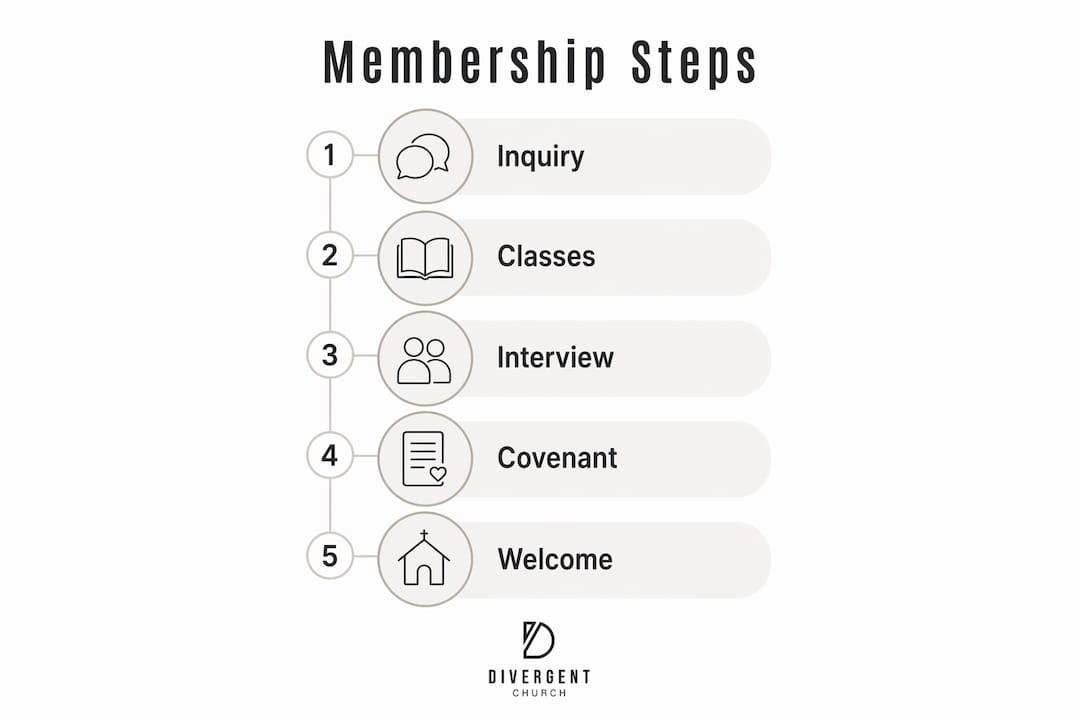
The church membership process is a structured pathway from interest to formal commitment. It varies between traditions, but most churches follow a recognisable sequence of steps. Understanding this process removes the mystery and helps you approach it with confidence.
Attend and observe. Before any formal steps, visit the church regularly. Observe the preaching, the community, and how leadership handles difficulty. Spiritual maturity includes taking at least 30 days to assess a church’s theological stance and community health before committing.
Attend a membership class. Most churches offer a membership class or orientation series. These sessions cover the church’s beliefs, values, leadership structure, and expectations. Depending on the tradition, these classes can run for a few weeks or up to a year.
Meet with a leader. Many churches require a personal conversation with a pastor or elder. This is an opportunity to share your faith story, ask questions, and affirm your theological alignment with the church.
Affirm a statement of faith. A formal profession of faith is standard across most traditions. You are publicly declaring what you believe and committing to live it out within this specific community.
Sign a membership covenant. Many churches use a covenant or membership agreement. This document outlines the mutual commitments of both the member and the church leadership.
Public welcome. New members are often welcomed publicly during a Sunday gathering, marking the formal beginning of their covenant relationship with the community.
Joining a church does not involve a financial fee. Voluntary financial giving is expected as part of faithful participation, but membership itself is free. The cost is not monetary. It is the cost of commitment, vulnerability, and showing up consistently.
Pro Tip: Ask the church directly how they handle conflict and pastoral care before you sign anything. A church’s answer to that question tells you more about its culture than any membership class ever will.
What are the different traditions and requirements for church membership?
Membership requirements vary significantly between Christian traditions. What qualifies you to join one church may differ entirely from another. Understanding these differences helps you navigate the process with clarity.

Tradition | Baptism requirement | Membership pathway |
Catholic | Infant baptism accepted | RCIA process, approximately one year |
Baptist | Believer’s baptism by immersion | Membership class and pastor interview |
Anglican | Infant or adult baptism accepted | Confirmation and profession of faith |
Pentecostal | Believer’s baptism common | Membership class and public commitment |
Presbyterian | Infant or adult baptism accepted | Profession of faith and elder interview |
The Catholic Rite of Christian Initiation of Adults (RCIA) is one of the most structured pathways, taking approximately one year and covering doctrine, sacraments, and community integration. Other traditions, particularly evangelical and Pentecostal churches, tend to have shorter processes focused on personal faith and biblical alignment.
Baptism sits at the centre of most membership discussions. Some traditions practise infant baptism and require confirmation as a later, personal affirmation of faith. Others, particularly Baptist and Pentecostal churches, require believer’s baptism by immersion as a prerequisite for membership. This is not merely procedural. It reflects deep theological convictions about the nature of salvation and the church.
Transfer members, those moving from one church to another, often need to provide documentation of their previous baptism or membership. Some churches recognise baptisms from other traditions. Others require rebaptism according to their own convictions. Always verify the specific requirements of the local church you are considering. A direct conversation with a pastor is the most reliable way to understand what is expected.
What are the practical benefits and responsibilities of church membership?
Church membership delivers real, tangible benefits. It also carries genuine responsibilities. Both sides of this covenant deserve honest attention.
Benefits of belonging
Pastoral care. Members receive direct access to pastoral support during personal crises, grief, illness, and major life transitions. Leaders are accountable to watch over members’ souls, a responsibility that requires knowing who belongs.
Community and belonging. Membership moves you from observer to participant. You become part of a church community that knows your name, shares your burdens, and celebrates your growth.
Opportunities to serve. Many churches reserve leadership roles, ministry teams, and teaching opportunities for members. Membership is the gateway to deeper contribution.
Spiritual accountability. A covenant community creates the conditions for honest, loving accountability. Growth accelerates when people around you are invested in your spiritual health.
Protection during crisis. Submitting to church leadership provides a safety net when personal or spiritual crises arise. Isolated believers are far more vulnerable to spiritual drift.
Responsibilities that come with membership
Membership is not a passive status. It is an active covenant. Members are expected to attend regularly, give generously, serve faithfully, and submit to the spiritual oversight of their leaders. This submission is not blind obedience. It is a willing trust in leaders who are themselves accountable to God and to the community.
Membership also involves transparency. A two-way covenant means leaders commit to oversight while members commit to honesty about their struggles, doubts, and failures. Pastoral intervention during seasons of unrepentant sin or crisis is part of this covenant, not a violation of it. The goal is always restoration and health, not punishment.
Pro Tip: Membership without active participation is just a name on a list. The benefits of belonging are proportional to the investment you make in the community.
A common misconception is that church membership gives leaders unchecked authority over members’ lives. The biblical model is shepherding, not control. Leaders serve the flock. Members thrive under that care. When both sides of the covenant are honoured, the church becomes what it was always meant to be: a community shaped by love, growing together in faith.
Key takeaways
Church membership is a covenantal commitment that transforms casual attendance into active, accountable belonging within a local church community.
Point | Details |
Membership is covenantal | It is a mutual commitment between the individual and the church, not a passive registration. |
Biblical basis is clear | New Testament letters assume identifiable, accountable local congregations with named members. |
Process varies by tradition | Steps range from short membership classes to year-long programmes like Catholic RCIA. |
Benefits require participation | Pastoral care, accountability, and service opportunities are available to active members. |
Traditions differ on baptism | Some require believer’s baptism; others accept infant baptism with later confirmation. |
Choosing a church: what I’ve learnt from getting it wrong first
The most common mistake I see people make is treating attendance as membership. They show up for months, feel connected, and assume they belong. Then a crisis hits and they realise no one is actually responsible for their care. That gap is painful and avoidable.
Visiting a church for at least a month before committing is not excessive caution. It is wisdom. Watch how the leadership handles conflict. Notice whether the community displays genuine love or just polished hospitality. Ask hard questions about theology, accountability, and what happens when someone struggles. A church that welcomes those questions is a church worth trusting.
Membership is also a step into vulnerability. You are not just joining a programme. You are placing yourself under the care of imperfect people who are trying to follow Jesus faithfully. That requires humility from you and from them. The churches I have seen thrive are the ones where both sides of that covenant are taken seriously.
My honest encouragement: do not wait for the perfect moment or the perfect church. Commit to a community that is genuinely shaped by Scripture, centred on Jesus, and honest about its own limitations. Then lean in. The seeds planted in faithful membership grow slowly, but they grow deep.
— Josh
Finding your place at Divergentchurch
Divergentchurch in Canberra exists for people who are ready to move beyond Sunday attendance into genuine, covenantal community. Whether you are exploring faith for the first time or looking to go deeper in your walk with Jesus, there are clear next steps available to you.
The Discipleship Hub at Divergentchurch offers structured pathways for growth, from foundational faith resources to leadership development. Life Communities connect you with a small group of people in your neighbourhood or stage of life, where real accountability and belonging take root. If you are ready to take the next step, the Next Steps pathway at Divergentchurch is designed to walk you through membership and discipleship at a pace that suits you.
FAQ
What does church membership mean for a Christian?
Church membership is a formal covenant between a believer and a local church, involving mutual accountability, submission to pastoral oversight, and active participation in the community’s life and mission.
Is church membership required to attend a church?
Attendance is open to everyone, but membership is a deeper commitment. It unlocks pastoral care, accountability, and service opportunities that casual attendance does not provide.
How long does the church membership process take?
The process varies by tradition. Some churches complete membership in a few weeks through a short class and interview. Catholic RCIA takes approximately one year.
Do I need to be baptised to become a church member?
Most traditions require some form of baptism, but the type and timing differ. Baptist and Pentecostal churches typically require believer’s baptism by immersion. Anglican and Presbyterian churches accept infant baptism with later confirmation.
What are the main benefits of church membership?
Church membership provides pastoral care, spiritual accountability, a defined community of belonging, and access to service and leadership opportunities within the local church.
Recommended
Comments