
What is church vision? A guide for leaders


Church vision is one of the most misunderstood concepts in ministry leadership. Ask ten church leaders what it means and you will likely hear ten different answers, most of them describing programmes, budgets, or weekend services. But what is church vision at its core? It is not a slogan on a website or a list of activities for the year. It is a God-given conviction about the future God intends to build through a particular community of believers. Getting this right shapes everything: your leadership culture, your community health, and the spiritual trajectory of every person in your care.
Table of Contents
Key takeaways
Point | Details |
Vision answers ‘where are we going?’ | Vision is distinct from mission and values, pointing toward the future God is calling your church toward. |
Vision prevents stagnation | Churches without clear vision risk operating on repetition rather than expectation, limiting kingdom impact. |
Vision must be shared widely | Keeping vision within leadership isolates it; the whole congregation must own it for momentum to build. |
Measurable outcomes are critical | Select three to seven specific vision outcomes over a three-year horizon to translate aspiration into progress. |
Vision drives obedience, not just activity | A genuine church vision calls people beyond comfort into kingdom-shaped living and mission. |
What is church vision, and how is it different from mission?
Many leaders collapse vision, mission, and values into one blurry concept. They are not the same, and the difference matters enormously for leadership clarity.
Vision answers ‘where are we going?’ while mission answers ‘what are we doing?’ Values, by contrast, describe how you behave along the way. These are three distinct questions, and each deserves its own honest answer.
Think of it this way. Two churches might share the same mission: making disciples of Jesus. But their visions could look radically different depending on their city, their calling, and the Spirit-prompted conviction of their leadership. Multiple churches can share a mission while having entirely different visions depending on context and calling. One church may feel called to reach university students in Canberra’s inner north. Another may be planting seeds in rural communities with no evangelical witness. Same mission. Completely different vision.
Here is a simple comparison to make this concrete:
Concept | Question it answers | Example |
Vision | Where are we going? | A city where every suburb has a reproducing missional community |
Mission | What are we doing? | Making and multiplying disciples of Jesus |
Values | How do we behave? | Prayerfulness, generosity, radical welcome |
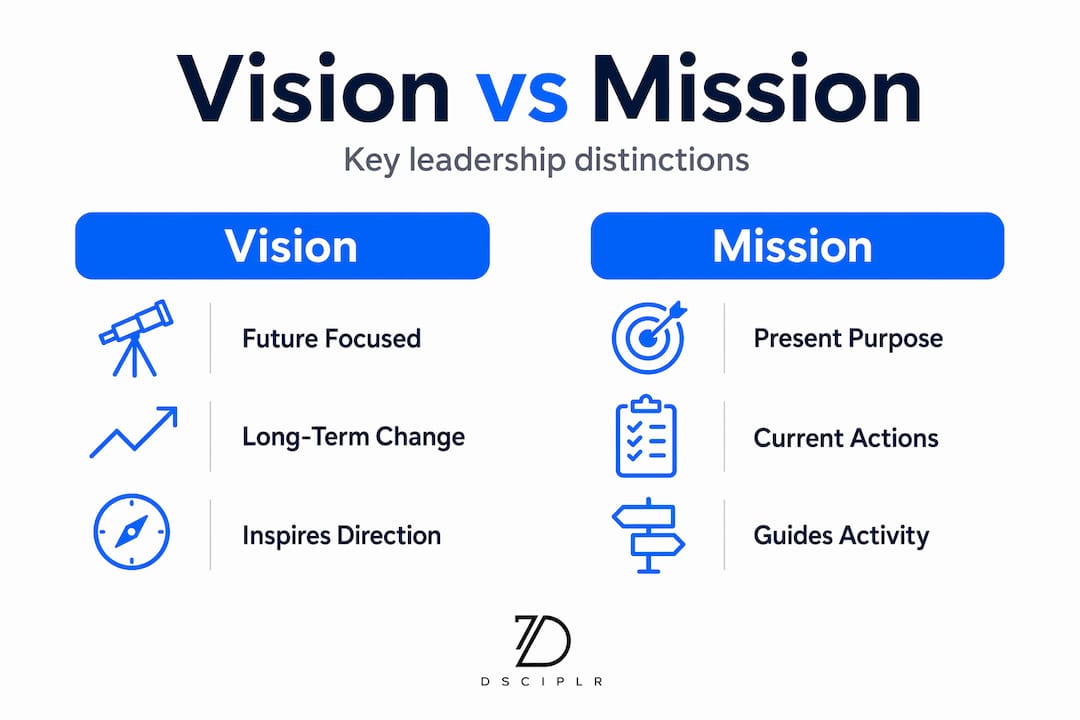
Vision statements highlight major long-term change and are future-focused, while mission statements describe what the church is actually doing right now. Confusing the two creates a leadership team that mistakes busyness for faithfulness. Programmes become ends in themselves rather than seeds planted toward a larger harvest.
Consider the missional church framework: it only makes sense when the vision behind the mission is clear. Without that forward-facing picture, even the most theologically sound mission can drift into routine.
Why church vision matters for growth and community
Here is a truth that does not get said enough: a church without a clear vision will still look busy. It will run programmes, host events, and preach sermons. But churches without clear vision operate on repetition rather than expectation, risking slow spiritual stagnation despite active calendars.
Vision matters because it does several things that activity alone cannot do:
It provides God-given direction. Vision is not a pastoral preference or a strategic plan. It is a conviction about where God is leading, shaped through prayer, Scripture, and the discernment of a community seeking Christ.
It aligns leadership. When every elder, ministry leader, and volunteer understands the same picture of the future, decisions become clearer and conflicts reduce. You are all building the same house.
It unifies the congregation. People give their best not to programmes but to a cause they believe in. A compelling vision draws people into something larger than themselves.
It energises obedience. Vision leads to obedience and kingdom outcomes rather than merely completed tasks. People step beyond their comfort when they can see where they are going.
It enables evaluation. Without vision, there is no meaningful way to assess whether what you are doing is actually working. Vision gives you a measuring stick.
Pro Tip: Write your church vision on a single page and ask five congregation members who were not involved in crafting it to read it. If they cannot tell you in one sentence where the church is heading, the vision needs sharpening.
The importance of church vision is most visible in contrast. At Divergent Church, the conviction has always been that community in Canberra is not just a context for ministry but the very soil into which the kingdom is being planted. That kind of vision is personal, local, and prophetic. It cannot be imported from another church’s strategy document.

How to define your church vision well
Developing a clear, compelling, and achievable church vision is not a weekend exercise. It takes prayerful discernment, honest conversation, and structural discipline. Here is a process that works:
Gather diverse voices prayerfully. Invite elders, ministry leaders, long-term members, and newer disciples into the conversation. Vision that emerges from the community carries more collective ownership than vision handed down from a single leader.
Anchor it in Scripture and local context. Ask: What has God spoken over this community? What needs in our city, suburb, or neighbourhood is He calling us to address? Divergent Church exists in Canberra, a city shaped by universities, government, and transience. That context is not incidental to vision. It is formative.
Keep it vivid and concise. A vision statement that requires three paragraphs to explain is not yet a vision. It is a draft. Aim for a single, memorable sentence or short statement that paints an aspirational picture of the future.
Identify three to seven measurable vision outcomes. Selecting specific measurable outcomes over a three-year horizon enables focused progress and genuine evaluation. These are not goals or tasks. They are descriptions of what success looks like.
Assign ownership and resources. Casting vision well requires moving from dreaming to commitment by assigning responsibility and ensuring outcomes are operationally achievable. A vision without someone accountable for it will remain aspirational.
Integrate vision into leadership rhythms. Review your vision outcomes in team meetings. Let them shape your annual planning cycle. Preach toward them. Budget toward them.
Pro Tip: Avoid the trap of listing current ministry activities as your vision. Many churches mistake vision for current goals rather than aspirational future outcomes. Pressure-test each planned activity by asking: does this directly advance our vision for formation, outreach, or community engagement?
If you are working through setting spiritual goals for your community, vision clarity is the necessary foundation before any goal-setting makes sense.
Communicating vision across your community
Even the most God-breathed vision will gather dust if it lives only in the minds of senior leaders. Vision creates momentum only when shared and reinforced among the whole congregation, not kept isolated within leadership.
This is where many churches stumble. The vision gets announced at a launch Sunday, printed in the bulletin, and then quietly forgotten as the weekly rhythms take over. Communicating the ‘why’ behind vision is what draws diverse people toward a shared purpose.
Practical ways to embed vision throughout your community:
Preach toward it. Sermon series should not just cover theological topics in isolation. They should connect Scripture to the vision God has given your community.
Celebrate vision-shaped stories. When a life is transformed, when a neighbour comes to faith, when a community partnership forms, name it as vision fruit. This reinforces what the church is actually for.
Train ministry leaders to speak vision language. Your children’s minister, your worship team, your small group leaders should all be able to connect their specific work to the bigger picture.
Use your church events as vision moments. Every gathering is an opportunity to reinforce the ‘why’ that holds the community together.
Revisit and refresh vision publicly. At least once a year, bring the whole congregation back to the vision. What has been achieved? Where are you now? What is next?
Communicating the ‘why’ behind vision fosters unity even among people with different preferences or backgrounds. This is how church unity becomes something more than a nice idea. It becomes a lived reality shaped by shared direction.
Applying vision to practical decisions
Vision is not just theology. It has direct implications for how you allocate resources, plan programmes, and engage the community around you.
In church facility planning, vision aligns leadership and guides partners, inspiring support and driving major decisions. Whether you are considering a building project, a new ministry partnership, or simply deciding which programmes to continue, vision is the filter. If it does not advance your vision for disciples and community, it demands scrutiny.
Here is a simple framework for applying vision to real decisions:
Decision area | Vision question to ask | Example |
Programme planning | Does this form disciples or reach people? | Retain only what advances your three-year outcomes |
Budget allocation | Are resources following vision priorities? | Fund what serves vision; defund what does not |
Community partnerships | Does this partner share our kingdom direction? | Pursue church partnerships that multiply impact |
Facility decisions | Does this space serve our ministry vision? | Build for mission, not for comfort |
Building a digital giving culture within your church community is one practical area where vision alignment matters. Generosity flows when people believe in the vision they are funding.
My take on vision in church leadership
I have seen what happens when a church lacks a genuine vision. I have walked alongside leaders who were genuinely godly and hardworking but whose communities felt like they were spinning wheels. Lots of activity, little transformation. No one could say where the church was actually heading.
What I have learned is this: vision is often treated like a marketing concept rather than a prophetic conviction. Leaders reach for slick language and impressive statements rather than sitting in the discomfort of asking what God is actually calling their specific community toward. That is a costly mistake.
The churches I have seen thrive are not always the largest or the best resourced. They are the ones where ordinary people can articulate, in their own words, what their community exists to accomplish and why it matters eternally. That kind of shared ownership does not happen by accident. It is cultivated over time through honest leadership, repeated communication, and the courage to say no to good things that are not the right things.
Vision must come from Christ’s calling, not from pastoral ambition or denominational expectation. When it does, it becomes the kind of conviction that outlasts any single leader and carries a community through seasons of difficulty and growth alike.
— Josh
Explore vision and leadership with Divergent Church
If this article has stirred something in you about the kind of community you want to build or be part of, Divergent Church has resources designed specifically to move you from aspiration to action. The Discipleship Hub offers practical tools for spiritual formation and leadership growth, grounded in the conviction that disciples are made in the rhythms of everyday life. For those called to lead, the Lead Like Jesus programme at Divergent Church Canberra offers a formation pathway rooted in servant leadership and kingdom vision. These are not just courses. They are communities of practice, shaping leaders who know where they are going.
FAQ
What is church vision in simple terms?
Church vision is an aspirational picture of the future God is calling a specific church community toward, answering the question ‘where are we going?’ It is distinct from mission, which describes what the church is doing right now.
How is a church vision different from a church mission statement?
A church mission statement describes the present purpose and work of a church, while vision describes the future it is working toward. Both are necessary, but they answer different questions and serve different leadership functions.
Why is church vision so important for leadership?
Without a clear vision, churches risk operating on repetition rather than expectation, producing activity without transformation. Vision aligns leaders, unifies the congregation, and gives the whole community a shared sense of where God is leading.
How do you define and write a church vision statement?
Gather diverse voices, anchor the vision in Scripture and your local context, and aim for a single memorable statement. Then identify three to seven measurable outcomes over a three-year horizon and assign clear ownership to each.
What makes a strong church vision?
A strong church vision is specific to the community’s calling and context, concise enough to be memorised, inspiring enough to motivate sacrifice, and connected to measurable outcomes that allow real evaluation of progress.
Recommended
Comments