
Why serve in church: faith, growth, and community


Most people assume serving in church is something the particularly devoted do. The helpers. The early risers stacking chairs at 7am. The ones who seem to have it all together spiritually. But that assumption misses something foundational about what the church actually is and what serving in it does to a person. When you begin to understand why serve in church matters, you discover it is not an add-on to your faith. It is the very shape of it. This article unpacks the biblical reasons, the research-backed benefits, and the practical pathways for anyone ready to move from Sunday observer to active participant in something much larger than themselves.
Table of Contents
Key takeaways
Point | Details |
Serving is theologically grounded | Every believer has spiritual gifts meant to build up the whole church body, not just themselves. |
Research confirms real benefits | Studies show serving strengthens spiritual peace, community belonging, and personal wellbeing. |
Transformation happens through service | Serving fosters humility, deepens relationships, and shapes character beyond what attendance alone can do. |
Discernment guides sustainable serving | Aligning your gifts and passions with genuine needs leads to deeper, more lasting involvement. |
Challenges are normal and surmountable | Burnout, doubt, and feeling unqualified are common. They do not disqualify you from serving meaningfully. |
Why serve in church: the biblical foundation
The question of why we serve is answered most clearly in 1 Corinthians 12. Paul describes the church not as an organisation with staff who do the work for everyone else, but as a living body where every member has a function. The eye cannot say to the hand, “I don’t need you.” The body is incomplete, weakened, when any part refuses to play its role.
This is not metaphor for motivation. It is doctrine with real consequences for how a church functions. When people opt out of serving, something genuinely goes missing. Gifts are not distributed by accident. They are given by the Spirit, as Paul writes, “for the common good” (1 Corinthians 12:7). That means your particular capacity — for hospitality, for teaching, for practical help, for encouragement — exists for the benefit of others, not just for your own spiritual enrichment.
There is also a Christological argument here worth sitting with. Jesus, the one who had every reason to be served, “came not to be served but to serve” (Mark 10:45). Serving in the church is an act of imitation. It is conforming to the character of Christ in the most tangible, everyday way possible.
“Pastors are called to equip the saints for works of ministry, for building up the body of Christ.” Ephesians 4:12
This verse is often read as a description of pastoral function only. But the full implication is that the congregation itself is meant to be doing the works of ministry. Pastoral theology frames service not as performance for numbers, but as committed care and relational presence.
Spiritual gifts are given for building others up, not accumulating personal spiritual experiences
Every role in the body carries dignity and necessity, from the most visible to the most hidden
Serving is a natural outworking of belonging to the church, not an exceptional act of devotion
Pro Tip: If you are unsure what your spiritual gifts are, start by noticing what you consistently feel drawn to do for others, and what energises rather than drains you. Often your gifts are already visible to those around you before you name them yourself.
Research-backed benefits of serving
It would be easy to dismiss serving as pure obligation, a spiritual duty disconnected from your actual wellbeing. But the research tells a different story.
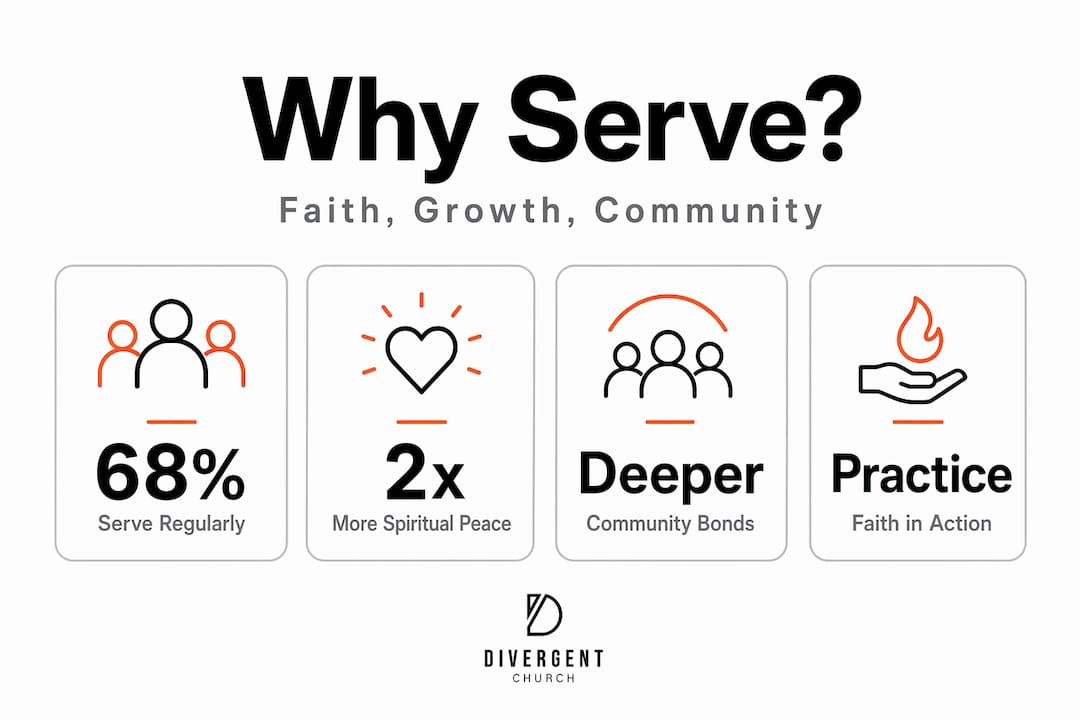
Lifeway’s 2026 research surveyed 2,130 Protestant churchgoers and found that 68% intentionally put their spiritual gifts to use serving God and others, while 67% serve in their communities outside the church. These are not passive attenders. They are people whose faith has taken on active, outward form. And crucially, serving functions as a mark of spiritual maturity alongside practices like prayer, forgiveness, and community care.
The Lake Institute’s summary of the Little Rock Congregations Study found that community engagement boosts spiritual peace and deepens members’ sense of the church as family. Those who serve are significantly more likely to invite others into the community, creating a compounding effect on belonging and growth.
Benefit | What the research shows |
Spiritual peace | Active community engagement correlates with greater personal spiritual wellbeing |
Sense of belonging | Servers are more likely to experience church as family rather than institution |
Social connection | Serving builds bonds that extend well beyond Sunday gatherings |
Faith maturity | Intentional gift use is linked to deeper, more integrated Christian living |
Community invitation | Those who serve are more likely to invite others to church |
Serving also produces something harder to quantify but unmistakably real. It anchors your faith in practice. You cannot remain abstract in your beliefs when you are rostered on for the children’s programme every third week, or when you are praying with someone after a service. Theology becomes lived rather than merely known.
Understanding what church community truly means deepens when you are not simply attending it but actively contributing to it. Service transforms your posture from consumer to co-builder.
How serving transforms individuals and communities
The impact of serving is not limited to the one who serves. When a person steps into a role with genuine faithfulness, something shifts in the whole community around them.

Serving teaches humility, fosters real relationships, and shapes people into who they are meant to be within the body of Christ. This is qualitatively different from simply attending church. Attendance can be done in relative anonymity. Serving requires you to show up consistently, learn other people’s names, and carry responsibility for something beyond yourself.
Real-world examples make this concrete. In Louisville, a historic church building is being renovated into a community hub hosting worship, a food pantry, and community services, all through a partnership with the local Molo Village CDC. This is not a church expanding its programme. It is a church becoming a neighbourhood. And it happens because people chose to serve beyond the four walls.
Here is how that transformation tends to unfold in stages:
You start small. A single role, a single team, a single morning. The commitment is low but the investment is real.
You build relationships. The people you serve alongside become your community. Bonds form around shared purpose rather than shared demographics.
You grow in character. Serving surfaces impatience, pride, and self-sufficiency in the most useful way. It is a mirror as much as a ministry.
You extend impact. Churches partnering with community organisations multiply their reach exponentially. Your single act of service joins a much larger story.
Pro Tip: If you are new to serving, look for teams that operate in rhythm. A regular Sunday team, a weekly community programme, or a monthly commitment does more for your spiritual formation than occasional large events.
Understanding the impact of church partnerships helps you see your individual contribution as part of a city-shaping mission rather than an isolated act of goodwill.
How to discern where and how to serve
The question of how to serve in church is both practical and spiritual. You are not simply filling a roster gap. You are offering something that belongs uniquely to you and that the body genuinely needs.
A few honest questions help here. What do you find yourself caring about most when you look at your church or your city? Where have others affirmed your contribution? What do you have capacity for, not just energy for, but genuine, sustainable capacity? These are not trivial questions. Getting this right means you serve well for years rather than burning out in months.
The importance of serving in church is also tied to consistency. Committed, rhythmic service integrates spiritually in a way that sporadic volunteering simply cannot. Showing up week after week with the same team, for the same purpose, builds something that a one-off event never will.
Start with one area rather than spreading yourself across multiple roles
Speak to church leaders about genuine needs before choosing a role based on comfort alone
Give your chosen area of service at least three months before evaluating whether it fits
Rest is not the enemy of service. A depleted server is not a faithful one
Review your involvement annually, asking both what you are contributing and what you are receiving
Discovering how to volunteer in church in Canberra is a genuinely personal process. The goal is not to do more but to serve well, from a place of genuine calling and sustainable rhythm.
Common challenges and misconceptions
There is a persistent and damaging idea that serving in church is for people who have arrived spiritually. The leaders. The mature ones. The people without complicated histories or demanding schedules.
That idea is worth confronting directly.
“God chose what is weak in the world to shame the strong.” 1 Corinthians 1:27
The body metaphor in Scripture actually lowers the barrier to entry. It affirms that the less visible roles are as necessary as the prominent ones. The person who faithfully prays for the congregation each week, unseen by most, is no less vital than the one who speaks from the front.
Other common barriers include:
“I don’t have enough time.” Most meaningful serving roles ask for two to four hours a month. The question is not time but priority.
“I’ll wait until I’m more ready.” Readiness largely comes through serving, not before it. Growth happens in the doing.
“Nobody will notice if I stop.” The body notices. The gap left by someone who withdraws is real, even when it goes unspoken.
“I tried before and got burnt out.” Burnout usually signals a mismatch between role and capacity, not a permanent disqualification from service. The answer is recalibration, not withdrawal.
Seasons of serving in difficult circumstances, when gratitude is scarce and the work feels thankless, are often where the deepest formation happens. Seeds planted in that kind of ground rarely go to waste.
My honest take on why serving matters
I have watched people come through church doors searching for meaning, connection, or simply a reason to keep going. And I have noticed a consistent pattern. The ones who find what they are looking for are almost never the ones who sit and wait for community to come to them. They are the ones who, often tentatively at first, choose to serve something beyond themselves.
What I have come to believe is that serving is not a path toward spiritual growth. It is the path. You cannot separate serving from Christian identity without losing something core to what following Jesus actually means. The incarnation itself is the model. God did not send instructions. He came and got his hands dirty.
The misconception I encounter most often is that people need to feel spiritually full before they can give. My experience is the opposite. Service produces fullness. The cup fills as it pours. What I have seen in people who commit to serving, even quietly and without recognition, is a groundedness and a sense of belonging that no amount of Sunday attendance alone creates. That is not a small thing. In a city like Canberra, where transience and isolation are real, it might be the most important thing the church offers.
— Josh
Serve with us at Divergent Church
At Divergentchurch, we believe that serving is one of the most formative things you can do in your walk with Jesus. It is how seeds of faith take root in the life of the city. It is how community becomes more than a word.
Whether you are exploring faith for the first time or looking to go deeper in your discipleship, there is a place for you to contribute here in Canberra. Our discipleship pathways connect you with serving teams, spiritual formation resources, and a community shaped around mission and genuine relationship. If you want to grow in your capacity to lead and serve like Jesus, our Lead Like Jesus programme provides practical and theological grounding for kingdom service. Find your place and begin.
FAQ
What does serving in church actually mean?
Serving in church means using your time, gifts, and presence to contribute to the life and mission of the congregation and its surrounding community. It includes everything from hospitality and children’s ministry to community outreach and behind-the-scenes support.
Why is the importance of serving in church so often overlooked?
Many people see church as something they attend rather than something they belong to and build. The biblical model, rooted in 1 Corinthians 12, makes clear that every member is necessary and that the church is weakened when people remain passive.
What are the real benefits of church service?
Research from Lifeway and the Lake Institute shows that serving strengthens spiritual peace, deepens community belonging, and increases faith maturity. Beyond the data, serving builds character and relationships that Sunday attendance alone cannot produce.
How do I know where to serve in church?
Begin by reflecting on your spiritual gifts, your genuine passions, and what your church or community actually needs. Start with one consistent role and give it time. Growth in serving usually comes through faithfulness over time, not through finding the perfect fit immediately.
Can I serve in church if I am still figuring out my faith?
Absolutely. Serving is one of the ways people come to understand their faith more deeply. You do not need to have all the answers before you can offer something meaningful. Many people find that the act of serving is itself what clarifies their faith and strengthens their sense of calling.
Recommended
Comments